




Jeep Off-Road+ Mode: How Does It Work?
Jeep Off-Road+ Mode Explained: Embark On Your Next Adventure With Confidence
A lot of Jeep owners know when a trail or muddy access road feels harder than normal, but they do not always know which setting will help without creating new problems. For drivers trying to make sense of Jeep Off-Road+ mode, the key is understanding that it changes how the vehicle delivers power and manages traction rather than changing the hardware underneath you. This guide from Crossroads Chrysler Dodge Jeep Ram of Henderson explains what the Jeep Off-Road+ mode does, how it differs from standard 4WD ranges, when to use it around Henderson, and how to avoid the mistakes that shorten confidence faster than any obstacle.
What “Off-Road+ Mode” Means
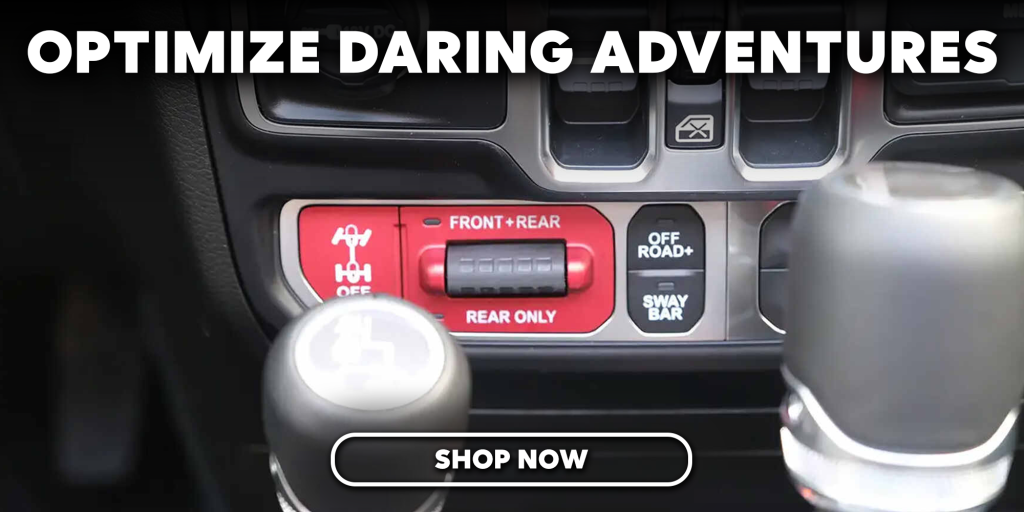
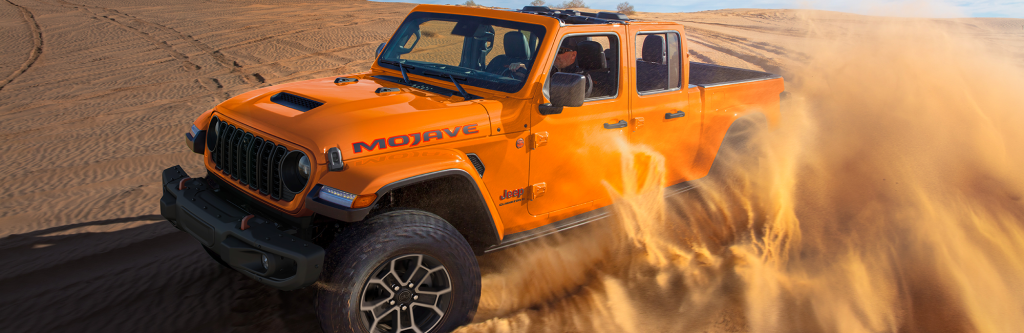
Off-Road+ is a performance-focused setting designed to enhance off-road performance by adjusting throttle response, changing transmission shift strategy, and reducing traction-control intervention to allow more wheel spin on loose surfaces like sand or gravel. In practice, it is most useful for faster off-road travel where maintaining momentum matters, rather than slow, technical rock crawling that depends more on precise drivetrain selection.
That distinction is the part many drivers miss: Off-Road+ is not the same thing as 4H or 4L. Jeep 4×4 systems use those ranges to manage gearing and drivetrain behavior, while Off-Road+ changes how the vehicle responds within that setup, so it acts more like a software strategy than a transfer case position.
The payoff is better traction and control in uneven conditions, but the limits stay physical. Jeep Off-Road+ mode cannot add ground clearance, improve tire pressure, or turn highway tires into all-terrain tires, which is why smart setup still matters more than button pressing.
Key Terms You’ll See in Your Jeep’s Menus
4H: High-range four-wheel drive for loose surfaces where you still need some speed and momentum.
4L: Low range for slower, more technical driving where added gearing helps control torque at low speed.
Throttle mapping: How the accelerator pedal translates your foot input into engine response.
Traction control: A system that manages wheelspin so one spinning tire does not waste all available grip.
Stability control: A system that helps the vehicle stay pointed where the driver intends during slides or abrupt weight shifts.
Availability and exact behavior vary by model, trim, and Jeep 4×4 systems, so two Jeeps may not react the same way even if both show a similar menu. That is why the owner’s manual matters more than assumptions based on another driver’s Jeep.
What Off-Road+ Mode Changes When You Turn It On
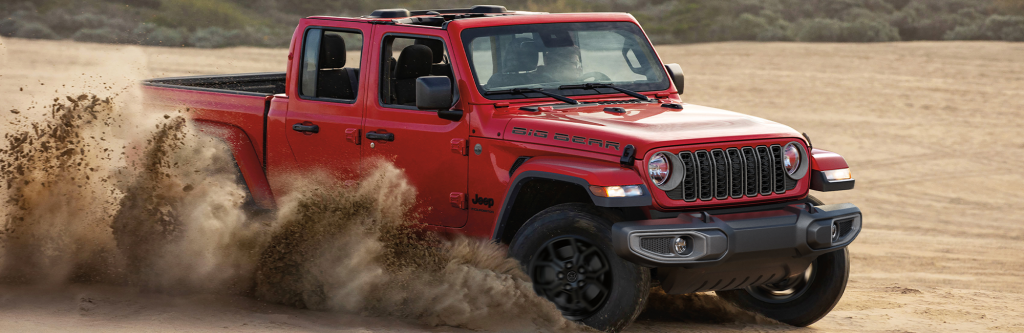
The first thing most drivers notice is sharper throttle response, because Off-Road+ changes the vehicle’s tuning and shift strategy to make it feel more responsive and torquey (often described as closer to a 4-Low-like feel while still in 4-High). Faster pedal reaction helps maintain momentum on climbs or in loose material, and momentum matters off-road because stopping in sand or mud often creates more work than moving through it smoothly.
Transmission behavior may change too, including holding gears longer and using an off-road-oriented shift strategy intended to keep usable power available on loose terrain. Keeping power available reduces hunting between gears, which can unsettle the vehicle on an incline or cause a loss of forward progress in terrain that rewards consistency.
Traction control and stability control logic may also become less restrictive because Off-Road+ reduces or detunes traction control and Electronic Stability Control intervention, so the Jeep can allow more wheel spin to maintain momentum on loose surfaces. That extra freedom is useful because some wheelspin can help clear tread and keep the Jeep moving, while the system still keeps guardrails in place to reduce uncontrolled slides.
How It Differs From Selec-Terrain® Modes
Selec-Terrain® settings such as Auto mode, Sand mode, Mud mode, and Rock mode are built around surface type. Off-Road+ is more aggressive where supported, because it works as a higher-performance off-road setting that can sharpen vehicle behavior beyond the baseline calibration chosen through the transfer case and terrain mode.
That means Selec-Terrain® is often the first adjustment, while Off-Road+ is the setting for a more demanding section. A driver might use Mud mode for a sloppy road, then add Off-Road+ where sustained traction and momentum become harder to preserve.
What It Does Not Do
Off-Road+ does not replace proper tires, careful line choice, or correct tire pressure. A software setting can help use the available grip better, but it cannot create grip that the tire and surface do not already offer.
It also cannot protect the underside from poor geometry. Approach angle, breakover angle, and departure angle still determine whether a Jeep clears an obstacle, so even capable vehicles can make underbody contact if the line is wrong.
When to Use Off-Road+ Mode Around Henderson
The best use cases are loose or uneven surfaces where normal calibration feels too timid. Rural driving around Henderson can include sandy patches, washed gravel, soft shoulders, and muddy access roads, and those surfaces reward steady momentum more than abrupt throttle.
Uneven terrain is another good fit. Rutted paths, wet fields after rain, and mild trail obstacles often demand a more responsive setup because the vehicle needs to keep moving without constant pedal corrections.
Short steep or slick sections also make sense for Off-Road+. Consistent power delivery helps the Jeep climb without repeated surges, which gives the driver more control and reduces the temptation to over-accelerate.
Local Driving Examples
After a storm, a driver might use Off-Road+ to work through a muddy driveway or farm access road with smooth throttle and limited wheelspin. That approach protects traction better than stabbing the pedal, which often polishes mud into a slicker surface.
On a weekend outing, Off-Road+ can help on loose gravel approaches or soft trail entrances before switching back to a calmer setting for pavement. The useful habit is treating the mode like a tool for a section, not a default for the full trip.
Where Not to Use It
Normal dry pavement is the wrong place for Off-Road+. The vehicle can feel abrupt, and using aggressive off-road calibrations on high-grip surfaces can add unnecessary driveline stress or reduce comfort.
Icy roads call for Snow mode and gentle inputs instead. Off-Road+ is not an ice setting, because ice usually rewards smoother, more conservative intervention rather than extra slip.
Step-by-Step: How to Engage Off-Road+ Mode Safely
Start by confirming the right base drivetrain setting for the terrain. In many situations, that means 4H for loose surfaces, while slow technical sections may call for 4L, so the Jeep uses low range for control rather than speed.
Next, engage Off-Road+ through the button or screen your Jeep uses. The exact steps vary by model, but Off-Road+ is commonly engaged in 4-wheel drive high (4H) by pressing and holding the Off-Road+ button until it illuminates.
Once engaged, drive with steady throttle and calm steering. Smooth inputs give the system time to manage traction, while sudden pedal or steering changes can upset the vehicle faster than any electronic aid can correct.
Quick Pre-Check Before You Switch Modes
Check tire condition and tread before leaving pavement, and secure or remove heavy cargo that can shift. Vehicle balance matters off-road because a sliding load changes weight transfer and reduces predictability.
Scan the terrain before entering it. Deep ruts, hidden rocks, and water crossings can create damage that no drive mode can prevent.
How to Exit Off-Road+ Mode
Switch back to a standard setting before sustained highway driving. If you used 4L, follow the owner’s manual to return safely to 4H, Auto, or another high range setting appropriate for normal travel.
Choosing 4H vs. 4L With Off-Road+ Mode
Use 4H for moderate-speed travel on gravel, sand, or light mud where momentum helps the vehicle float over loose material, and keep speeds within what is recommended for 4H use (commonly advised not to exceed about 50 MPH, depending on conditions and model guidance). In those conditions, Off-Road+ can sharpen throttle response enough to keep the Jeep moving without demanding excessive speed.
Use 4L for steep grades, deep ruts, and careful crawling where control matters more than pace. Lower gearing multiplies available torque and makes slow movement easier to manage, which reduces brake use and improves precision.
A practical rule is this: if you keep braking to stay slow, move to 4L; if you are struggling to keep moving through a loose section, 4H with Off-Road+ may fit better. Good off-road driving is often less about power and more about matching gearing to the obstacle.
Driver Feel Cues That Tell You to Change Settings
If the tires spin but the Jeep does not advance, stop and reassess. That usually points to line choice, tire pressure, or the need for more control through 4L rather than more throttle.
If the engine bogs in soft sand, smoother throttle with Off-Road+ in 4H may help maintain momentum. Sand punishes hesitation, so the right setting can make the Jeep feel more consistent rather than more aggressive.
Model Context: Which Jeep Vehicles Commonly Offer Off-Road+
Off-Road+ mode is most often associated with trail-focused Jeep configurations and higher-capability trims, but availability depends on the exact equipment. For example, Off-Road+ is associated with the Jeep Wrangler and Jeep Gladiator, being highlighted as an available feature.
That variation matters because feature names can sound similar while behavior differs by platform. A window sticker and owner’s manual give the clearest answer on whether a specific Jeep includes Off-Road+ and how that system interacts with its transfer case, Selec-Terrain® settings, and 4WD hardware.
How Our Dealership Explains It to New Owners
Our team at Crossroads CDJR of Henderson frames Off-Road+ mode as a learning tool, not a substitute for judgment. Drivers who understand what the vehicle is changing tend to use smoother inputs, create less wheelspin, and practice more responsible off-roading.
We also stress that the owner’s manual is the final reference for any exact Jeep configuration. That keeps expectations realistic and helps new owners avoid treating one Jeep’s settings as universal.
Common Mistakes Henderson Drivers Make With Off-Road+ Mode
One common mistake is using aggressive settings on dry pavement and then blaming the vehicle for jumpy behavior. The calibration is built for loose surfaces, so harshness on pavement is often a sign of misuse rather than a mechanical problem.
Another mistake is relying on Off-Road+ mode instead of reducing speed, choosing a better line, or fitting proper tires. Electronic aids help manage traction, but driver technique still decides whether the Jeep glides through an obstacle or digs itself deeper.
A third mistake is leaving Off-Road+ mode on after the obstacle ends. Once the muddy climb, gravel stretch, or rutted section is over, returning to a standard mode gives a calmer drive and avoids unnecessary wear.
Final Takeaways for Using Off-Road+ Mode in Henderson, NC
Off-Road+ changes throttle, shifting, and traction or stability logic to help the Jeep work better in tougher terrain. The key insight is that it adjusts vehicle behavior, not vehicle dimensions, so it works best when paired with the right tires and realistic expectations.
Choose the base range first, then use Off-Road+ for the obstacle rather than the whole drive. Drivers who match 4H or 4L correctly usually need less wheelspin, less correction, and less recovery effort.
Review your owner’s manual section on 4×4 operation and drive modes. Practice in a safe, open area before trying harder terrain, because familiarity with controls matters more than memorizing feature names. If you are comparing new Jeep models, ask how the specific vehicle’s off-road settings are configured and what each one changes. At Crossroads CDJR of Henderson, our team sees the most confident owners treat these systems as tools that reward preparation, smooth inputs, and patience. Visit us to find the perfect Jeep to explore Off-Road+ mode with!
FAQs
What is the off-road mode on a Jeep?
A Jeep off-road mode adjusts traction and vehicle response for loose or uneven surfaces. Depending on the model, that can include Selec-Terrain® settings and Off-Road+.
Do I put my Jeep in 4H or 4L?
Use 4H for loose surfaces where you still need moderate speed and momentum. Use 4L for slow, technical driving where low-speed control and added torque matter more.
Can I use Jeep Off-Road+ mode on regular roads?
It is designed for off-road conditions, not normal paved driving. On regular roads, a standard mode is the better choice for smoother response and proper system behavior.
Which Jeep models offer Off-Road+ mode?
It is commonly found on select off-road-focused trims of the Jeep Wrangler, Jeep Gladiator, and other capable Jeep vehicles, including select Jeep Grand Cherokee models. Availability depends on drivetrain and equipment.
When should I use Jeep Off-Road+ mode?
Use it on challenging terrain such as loose gravel, mud, sand, or uneven trail sections. Engage it only when conditions call for it, then switch back once the obstacle is done.
Top Off-Road Trails In North Carolina To Take Your Jeep: Local Routes And Nearby OHV Areas
North Carolina lists multiple designated OHV (off-highway vehicle) systems for Jeep off-road trails across national forests, private parks, and mapped back roads. This gives drivers in Henderson, NC, and surrounding areas more legal route variety than many nearby regions. For shoppers comparing Jeep off-road trails around Henderson, NC, that range matters because the right trail depends less on hype and more on access rules, surface type, and how your vehicle is equipped. This guide from Crossroads Chrysler Dodge Jeep Ram of Henderson helps you discover where to go, which model suits your adventures best, and how to plan a day that stays fun, legal, and manageable.
How We Chose These Jeep Trails Near Henderson
We selected routes and riding areas by looking at drive time from Henderson, NC, legal access, terrain variety, GPS navigation reliability, and whether mapping remains dependable once cell service fades. A scenic trail is not useful if the gate is closed, the route is private, or the mapping is too weak to support safe off-road driving.
For this list, “Jeep-friendly” means a route can reasonably fit a Jeep platform while accounting for width, mud, sand, rock, and recovery risk that may require recovery gear or a spotter. Each option notes likely difficulty, seasonal changes, and whether an OHV permit may apply, so you can compare nearby tracks, user reviews, trail ratings for routes like Hurricane Creek Off-Road Trail, and T.R.E.A.D. principles before heading out.
Many drivers also use a trail directory, elevation gain information, camping waypoints, waypoints for navigation, and points of interest when planning trips. These tools help narrow down Henderson, NC, Jeep off-road trails into realistic choices instead of chasing the hardest line on the map.
Our team at Crossroads CDJR of Henderson sees that the best trail day starts with matching the optimal vehicle to the route, not forcing the route to fit the vehicle. That approach helps drivers narrow Henderson, NC, Jeep off-road trails into realistic choices instead of chasing the hardest line on the map.
Quick Safety and Legality Checklist
Before embarking on off-road trails with a Jeep, check land rules before you leave, especially on USDA Forest Service property, game lands, and private parks where designated trails and permit rules differ. Staying on marked routes and following pack-in/pack-out practices protects access, which is the factor that decides whether a trail remains open next season.
Verify whether an OHV permit, or OHV pass, is required before arriving. Always check land management updates and trail closures before departure because access rules can change throughout the year.
Carry a full-size spare tire, know where you will air down and air up, and bring a backup communication plan. Those basics solve the most common trail-day failures, and they matter more than adding speed or difficulty.
Off-Road Pre-Trip Checklist
Match the Jeep off-road trail to your build before you match the trail to your schedule. A stock Jeep with all-terrain tires may handle forest roads and mild mud well, while steeper routes often reward skid plates, stronger sidewalls, a tire pressure gauge, and a clearer understanding of approach angle, departure angle, and breakover angle.
North Carolina seasonal conditions change trail character fast because clay mud, standing water, and storm runoff can turn an easy line into a recovery problem. Checking a current trail map, trail closures, and weather before departure reduces the chance of finding a washed-out route after you have already committed hours of driving.
Use offline maps, offline navigation, GPS navigation, set a firm turnaround time, and avoid solo travel on harder routes. Those habits matter because the most expensive trail mistake is not a dented skid plate, but a late recovery in fading light with no reliable signal.
What to Bring for a Day on the Trails
Pack a rated tow strap, D-ring shackles, traction boards, a tire repair kit, recovery gear, and enough tools to handle minor issues after water crossings or sharp rock contact. A winch can also be useful on more challenging routes. Recovery items are not overkill in North Carolina because soft shoulders and hidden ruts can trap even capable four-wheel-drive vehicles.
Always verify that recovery points are properly rated before using recovery equipment. A full-size spare tire remains one of the most important items for remote trail travel.
Add a first-aid kit, drinking water, a headlamp, and a communication method that works without cell service to your Jeep off-road trail essentials. Safety gear earns its value when weather shifts or a short trail run turns into a longer exit than planned.
Trail Etiquette That Keeps Access Open
Stay on the trail, follow yielding rules, yield where appropriate, keep speeds down, and respect closures even if user reviews claim a bypass is open on your Jeep off-road trail adventure. Tire damage to wet edges and illegal reroutes often creates the evidence that land managers use to tighten access.
Follow the T.R.E.A.D. principles and pack-in/pack-out practices to protect public access. Keep noise controlled near camps, hikers, horses, and wildlife, and pack out everything you brought in. Trail etiquette is not a courtesy detail, it is the operating standard that keeps public access defensible.
Top Jeep Models to Off-Road With
To get the most optimized Jeep off-road trail experience, you will need to be equipped with a ride that will take you everywhere you need to go. Models like the Jeep Compass, Jeep Wrangler, and Jeep Gladiator are sturdy builds that are sure to exceed your expectations.
Jeep Compass
The Jeep Compass fits drivers who want modest off-pavement access without stepping into a larger footprint. It is better suited to mapped scenic routes and lower-risk exploration than deep mud, technical obstacles, or serious rock crawling. The Jeep Compass works best for lighter exploration, graded dirt, and mild forest-road travel, where compact size helps on tighter routes. Its value is practicality because it gives Henderson drivers a manageable daily vehicle that can still handle entry-level dirt and gravel adventures.
Jeep Wrangler
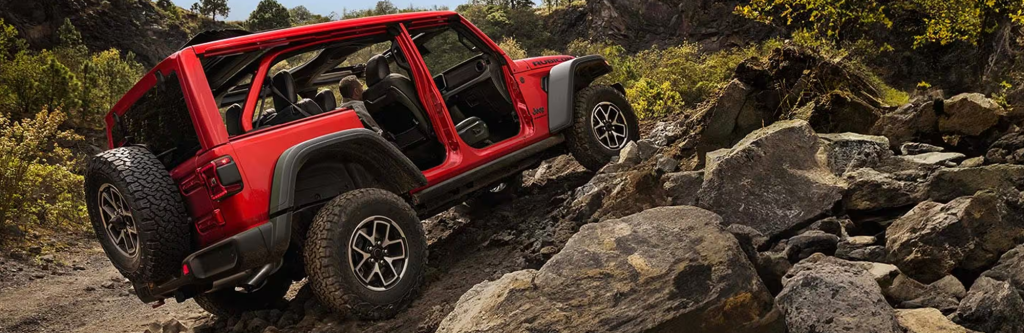
The Jeep Wrangler is the clearest fit for dedicated trail use because ground clearance, articulation, aftermarket support, and available off-road upgrades align with North Carolina OHV conditions. It also scales well from stock trail days to more advanced builds with mud-terrain tires, lift kit upgrades, and additional recovery equipment. The Jeep Wrangler remains the benchmark for technical trail use because body-on-frame design, removable doors and roof, available locking differential options, and off-road hardware suit mixed terrain.
Jeep Gladiator
The Jeep Gladiator suits drivers who need truck utility without giving up serious trail potential. Its longer wheelbase can reduce breakover margin, but the bed adds practical space for tools, spares, and camping gear. The Jeep Gladiator adds pickup utility to similar trail capability, which matters for drivers who want recovery gear, camping equipment, or work cargo in the same vehicle.
Local Beginner-Friendly Routes Near Henderson, NC
Next, it is time to hit the Jeep off-road trails! At Crossroads CDJR of Henderson, we have listed some popular routes most compatible for North Carolina drivers looking to take their Jeep on its next getaway. Mapped local routes are a strong first step for stock Jeep Wrangler owners and first-time trail users who want a lower-risk day close to Henderson. The main advantage is context because route notes, distance estimates, terrain descriptions, GPS navigation, and route-planning tools reduce guesswork before you leave pavement.
Expect surface changes after rain, occasional gates, and seasonal closures that can alter a familiar route. Download offline maps before losing signal, and use listed waypoints to confirm turns rather than assuming every dirt road is public access.
Pros
Local route libraries make it easier to find legal entry points and compare route length with your available time. Waypoints also help with planning fuel, scenic stops, camping waypoints, and turnaround locations.
Cons
Listings can change, so verify gates and access rules before departure. Even beginner routes can hide mud holes, washouts, or slick clay after storms.
Option 1: Chowan Swamp Gamelands (Including Chowan Gamelands – Deer Spotter Routes)
Chowan Swamp Gamelands fits drivers who want scenery, wildlife viewing, and flatter terrain when mountain routes are icy or less practical. This Jeep off-road trail stands out for swamp ecology and soft-ground travel, which creates a different challenge than rock crawling and rewards patience over speed.
Expect sandy sections, standing water in wetter months, and tighter rules tied to game lands access and hunting seasons. Routes sometimes associated with Chowan Gamelands – Deer Spotter travel areas require additional planning and awareness of seasonal conditions. That planning step matters because a route that feels easy in dry weather can become a recovery situation once the ground saturates.
Pros
The terrain is usually less technical than rock trails, which makes it a useful confidence builder. The scenery also offers a distinct eastern North Carolina trail experience.
Cons
Wet conditions can turn flat roads into stuck points with little warning. Access can be more restrictive than a dedicated OHV park.
Option 2: Uwharrie National Forest (Badin Lake OHV Complex)
Uwharrie National Forest is the best-known day-trip option from Henderson for drivers who want a dedicated OHV network with established Jeep traffic. The Badin Lake OHV Complex and Badin Recreation Area give you a clearer legal framework than scattered back roads, which lowers uncertainty and raises planning quality.
Expect mixed difficulty on these Jeep off-road trails, heavier weekend traffic, and pass requirements depending on current USDA Forest Service rules. Related North Carolina OHV names such as Black Swamp OHV Area and Wayehutta OHV Area show how the state organizes designated systems, but Uwharrie remains the most practical central option for many Henderson-area drivers.
Popular Jeep off-road trails include Dickey Bell and Dutch John, both well known within the Badin Lake OHV Complex. Features such as Roller Coaster Drop, embedded rock layers, steep climbs, technical obstacles, mud holes, washouts, and water crossings make route selection important.
Some OHV systems also maintain spark arrestor requirements, helmet requirement rules, age restrictions, alcohol prohibition policies, and other safety regulations depending on vehicle type and trail designation. These requirements may be especially relevant for ATV, SxS, and dirt bike riders.
Pros
A designated system reduces guesswork around legality and route choice. The obstacle range also supports skill progression from mild trails to more technical lines.
Cons
Crowds and trail wear can increase difficulty after rain. Pass rules and seasonal restrictions require pre-trip verification.
Option 3: Brown Mountain OHV Area (Steeper, More Technical Day Trip)
Brown Mountain OHV Area suits drivers seeking steeper grades, tighter lines, and more technical terrain than typical forest roads. Ground clearance, aired-down tires, and solid recovery points matter here because steep climbs and underbody contact are more common than on beginner Jeep off-road trails.
This would make for a longer day from Henderson, so treat it as an all-day commitment and travel with a group if possible. The benefit is a stronger skill ladder since moderate sections can prepare drivers for harder terrain without guessing where the challenge starts.
Drivers should monitor seasonal conditions during spring, summer, fall, and winter because trail difficulty can change significantly based on weather and trail maintenance.
Pros
The area offers a clearer progression from moderate routes to harder climbs. Group etiquette and spotting practices are also more established in dedicated OHV culture.
Cons
The drive is longer and the terrain creates more wear on tires, brakes, and suspension. A stock setup may reach its limits faster here than in Uwharrie.
Option 4: Brushy Mountain Motorsports Park (Park-Style Trails and Obstacles)
Brushy Mountain Motorsports Park is a strong fit for Jeep Wrangler and Jeep Gladiator owners who want marked routes, short-to-mid trail segments, and repeated practice on technical obstacles. A private park format helps drivers isolate skills such as tire placement, spotting, and throttle control without committing to a long backcountry loop.
Expect fees, park rules, and obstacle-focused terrain that can stress parts more than scenic overlanding Jeep off-road trails. That tradeoff can be useful because controlled repetition often teaches more than one long trail with few chances to practice.
The park is also popular among Jeep, ATV, SxS, and dirt bike enthusiasts looking for organized riding opportunities.
Pros
Trail variety in one place makes it easier to choose a route that matches your build. The park format also supports skill development in a more predictable environment.
Cons
Private park costs and rules apply. Obstacle-heavy driving can be harder on components than forest road exploration.
Hit the Trails
For Henderson drivers, the best starting points for Jeep off-road trails are usually local mapped routes, Chowan Swamp Gamelands for scenic lowland exploration, and Uwharrie for a fuller OHV experience. The Jeep Compass fits lighter route discovery, while the Jeep Wrangler and Jeep Gladiator make more sense for technical North Carolina terrain and repeated off-road use.
Look for legal forest roads, designated trails, and OHV areas such as Uwharrie National Forest, Badin Recreation Area, Black Swamp OHV Area, Wayehutta OHV Area, and more routes we will be happy to provide more information on. Drivers interested in overlanding should carry offline maps, GPS navigation backups, camping waypoints, emergency supplies, and recovery gear appropriate for the route.
Our team at Crossroads CDJR of Henderson helps shoppers think through how a vehicle will be used before the first trail day, which is the practical way to approach Jeep off-road trails in Henderson. If you are comparing trail-friendly options for weekends across North Carolina, visiting us can help you evaluate which Jeep model fits your route plans, cargo needs, and comfort with harder terrain.
FAQs
Are there Jeep trail etiquette rules to follow?
Yes. Stay on designated routes, yield appropriately, keep speeds down near others, avoid spinning tires in mud, follow T.R.E.A.D. principles, and pack out all trash to help keep trails open.
Where to go overlanding in North Carolina?
Look for legal forest roads, designated OHV areas, and Jeep off-road trails in Henderson or throughout North Carolina, including Uwharrie National Forest. Bring offline maps, GPS navigation, confirm seasonal closures, and check permit rules before you drive.
Where to get Uwharrie OHV pass?
Uwharrie passes are commonly available online, with local options sometimes changing by season or Forest Service rules. Confirm current requirements before departure.
Do I need a permit to drive OHV trails in North Carolina?
Some areas require an OHV permit or OHV pass before entry. Requirements vary by location and may change based on USDA Forest Service policies, seasonal conditions, or land management updates.
What should I bring for Jeep off-road trails in Henderson?
For Henderson, NC, Jeep off-road trails, bring recovery gear, a tow strap, D-ring shackles, traction boards, a tire repair kit, a tire pressure gauge, offline maps, water, and a full-size spare. More difficult routes may also justify a winch and additional recovery equipment.
Are all North Carolina off-road trails open year-round?
No. Trail closures can occur because of weather, maintenance, wildlife management, seasonal conditions, or safety concerns. Always verify current access information before heading to any Henderson, NC, Jeep off-road trails or other off-road destinations across North Carolina.
Off-Roading With A Jeep Gladiator: Your Guide To Adventure
The Jeep Gladiator combines a pickup bed with Trail Rated® capability, a mix that still stands out because few midsize trucks are engineered first for trail geometry and low-speed control. For shoppers comparing Jeep Gladiator off-road use with daily utility, that matters because traction, articulation, and cargo flexibility rarely arrive in one factory package. Around Henderson, NC, this opens practical use cases that range from muddy access roads to weekend forest roads, so the right trim depends on where and how you drive. Read our blog from Crossroads Chrysler Dodge Jeep Ram of Henderson to learn more about your next off-road truck.
What “Off-Road” Means for a Jeep Gladiator
Off-road capability in a Jeep Gladiator is not one feature but a system built around traction, ground clearance, wheel travel, and driver judgment. Jeep’s body-on-frame construction gives the truck the structural toughness needed for twisting terrain, loaded beds, and repeated impacts that would stress lighter-duty designs.
The Trail Rated badge signals that the Jeep Gladiator has been evaluated for traction, water fording, maneuverability, articulation, and ground clearance, but the badge does not replace technique. A locking differential can keep power moving to the wheel with grip, yet the driver still has to choose the right line, throttle input, and speed for the surface ahead.
Jeep Gladiator Off-Road Features
The Jeep Gladiator earns its reputation through hardware that supports both trail work and overlanding, not through appearance packages alone. That difference matters because long-distance dirt travel asks for durability, cooling, axle strength, and traction management that can handle hours of punishment rather than one short obstacle.
Off-Road+
If you’re wondering what the Jeep Gladiator Off-Road+ is, you’ll learn that it adjusts throttle, shift behavior, and traction strategy for loose terrain. This helps the truck respond more predictably when surfaces break away under the tires. On a Jeep Gladiator fitted with mud-terrain tires for trail use, this can reduce the hesitation drivers sometimes feel when climbing soft ground or crossing uneven ruts.
Dana® Heavy-Duty Solid Axles
The Dana solid axles remain central to the Jeep Gladiator formula because they are built to handle articulation and impacts from rocks without the same compromise in wheel placement found in softer road-focused setups. On uneven trails, that axle design helps keep tires in contact with the ground, which is the foundation of traction before lockers, gearing, or tire choice enter the conversation.
Selec-Terrain® Drive Modes: How to Choose the Right Setting
The Selec-Terrain® system lets drivers match traction behavior to surface conditions rather than relying on one generic 4×4 calibration. Snow, sand, and rock each demand different wheel-slip tolerance, so choosing the proper mode can improve control and reduce the abrupt wheelspin that makes rough terrain harder than it needs to be.
Jeep Gladiator Rubicon for Technical Trails and Rock Features
The Jeep Gladiator Rubicon is the factory choice for harder trails because it concentrates on articulation, underbody protection, and slow-speed precision. That focus matters on steep climbs and ledges where momentum becomes a liability, and controlled tire placement decides whether the truck clears an obstacle cleanly.
The Jeep Gladiator Rubicon is equipped with the Rock-Trac® 4×4 system and a best-in-class 84:1 crawl ratio, giving the driver finer control over torque delivery on technical terrain. An electronic sway bar disconnect increases front suspension articulation, which helps the tires stay planted on offset surfaces where one wheel would otherwise hang light and lose grip.
Specs, Features, and Experience
Factory trail hardware reduces the need for immediate major upgrades, especially for drivers who want to explore rockier routes without rebuilding the truck first. Skid protection, gearing, an upgraded Dana® 44 axle system, and articulation work together, so the Jeep Gladiator Rubicon feels composed on uneven shelves, steep descents, and off-camber sections that punish less specialized setups.
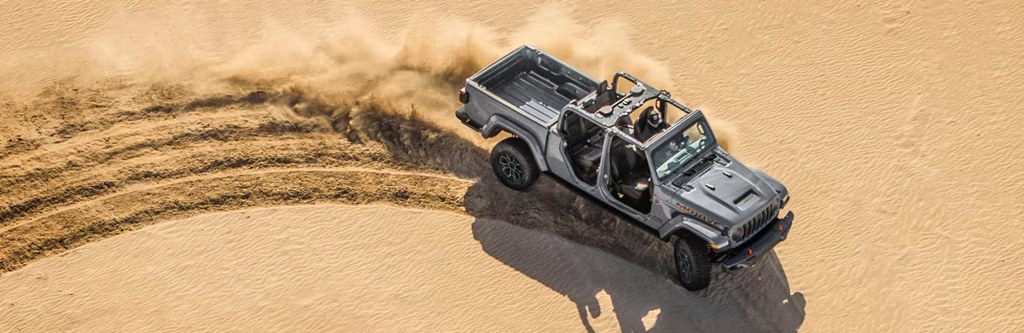
Jeep Gladiator Mojave for High-Speed Dirt and Rough Roads
The Jeep Gladiator Mojave is tuned for faster dirt travel, washboard surfaces, and rough two-tracks where suspension control matters more than max crawl ratio of the Jeep Gladiator Rubicon. That mission changes the driving experience because stability at speed reduces fatigue and keeps the truck settled over repeated hits that can upset slower-trail suspensions.
Where the Jeep Gladiator Rubicon is calibrated for technical crawling, the Jeep Gladiator Mojave is built to carry pace across broken ground with more composure. For Henderson-area drivers who spend time on long unpaved routes, hunting land access roads, or broad fire-road style terrain, that difference can matter more than ultimate rock capability.
Specs, Features, and Experience: Only One That Is Desert Rated
The Jeep Gladiator Mojave is the only Desert Rated® model in the lineup, and that label reflects intent rather than branding language. Its suspension tuning gives drivers more confidence on rough, faster dirt, and the comfort advantage becomes clear on extended unpaved stretches where repeated impacts can wear down both vehicle and driver.
How to Choose for Henderson, NC: Terrain, Weather, and Practical Needs
In Henderson, NC, trim choice should start with terrain and weather rather than badge preference. Rainy periods can turn mild trails into mud-heavy routes, so traction aids and tire selection often matter more locally than pure rock-crawling hardware unless your driving regularly includes technical obstacles.
Daily practicality also deserves equal weight because the Jeep Gladiator still has to park, ride acceptably, and carry gear through the week. The Jeep Gladiator offers towing capacity up to 7,700 lbs. and payload up to 1,720 lbs. when properly equipped, which makes the towing figure relevant for small boats, utility trailers, and camping loads without giving up trail access.
Beginner-Friendly Off-Roading Skills That Matter
A new driver should know the truck’s approach angle, departure angle, and breakover angle before dropping into a rut or cresting a mound. Those measurements translate the spec sheet into damage prevention, because poor angle awareness is how bumpers, rocker panels, and underbody components meet the trail.
Vehicle preparation matters as much as confidence, especially on unfamiliar routes. Use a spotter, travel with a second vehicle when possible, and treat line choice as a skill rather than a guess, because recovery mistakes tend to cost more than cautious driving.
Trail Prep Checklist: Tires, Protection, Recovery, and Tech
Before taking the Jeep Gladiator off-road, it’s important to make a thorough plan. Start with tires because they shape grip, ride, and puncture resistance more than most bolt-on parts. All-terrain tires suit mixed road and trail use, while mud-focused patterns help in sloppy ground but can trade away road manners; either way, proper pressure and safe airing down improve contact patch performance.
Protection should target the parts most likely to hit first when off-roading with a Jeep Gladiator, especially the transfer case area, lower control-arm zones, and rocker sections. Steel skid plates and rock rails matter because underbody damage often happens on obstacles the driver never sees from the seat.
Recovery gear should be selected before the trail, not after getting stuck. At minimum, verify recovery points, carry a recovery strap, rated shackles, and traction boards, and know who is leading the pull before tension goes into the line.
Using 4×4 Systems and Drive Modes
Use 4H for loose surfaces where speed stays moderate and traction changes constantly, and use 4L when low-speed control and torque multiplication matter more than momentum. The Selec-Terrain® traction management system helps by tailoring wheel-slip response for surfaces such as sand, snow, and rock when equipped.
Common Wear and Rust Prevention in North Carolina
North Carolina mud and standing water can trap moisture in places owners rarely inspect. After returning from taking the Jeep Gladiator off road, rinse the frame, underbody seams, drain holes, rocker areas, and exposed fasteners after mud or brackish water exposure, because corrosion often starts where dirt stays packed the longest.
Choosing the Right Jeep Gladiator
The Jeep Gladiator stands out because it combines body-on-frame toughness, serious 4×4 hardware, usable bed space, and available trail-focused equipment in one truck. On a broad scale, the formula works for drivers who want one vehicle that can handle work gear during the week and trail miles on the weekend.
The Jeep Gladiator Rubicon and Jeep Gladiator Mojave serve different priorities, and neither is the universal answer. Choose the Jeep Gladiator Rubicon if your route includes technical climbs, rocks, and low-speed obstacles. Conversely, choose the Jeep Gladiator Mojave if your priority is faster dirt travel and suspension composure over rough ground.
A common Henderson-area use case is hauling camping gear or a small trailer, driving pavement to a forest access point, and then continuing onto wet, rutted trails where clearance and traction matter more than appearance. If you want help comparing the current Jeep Gladiator trims in person, visit us at Crossroads CDJR of Henderson for a test drive.
FAQs
What is the difference between the Jeep Gladiator Rubicon and Jeep Gladiator Mojave?
The Jeep Gladiator Rubicon is tuned for technical trails, rock features, and low-speed control. The Jeep Gladiator Mojave is tuned for faster dirt, rough roads, and desert-style stability.
How many inches of ground clearance does the Jeep Gladiator have?
The Jeep Gladiator offers up to 11.6 in. of ground clearance. That figure matters most when crossing ruts, rocks, and uneven washouts without striking the underbody.
How many inches of water fording does the Jeep Gladiator have?
The Jeep Gladiator offers up to 31.5 in. of water fording. Water depth still requires caution because bottom conditions, current, and entry angle can change the risk quickly.

Off-Roading With A Jeep Compass: Your Guide To Adventure
A lot of drivers in Henderson, NC, want one vehicle that can handle weekday pavement and weekend dirt without pretending to be a dedicated rock crawler. Understanding Jeep Compass off-road capability starts with knowing where this Jeep compact SUV performs well, where its limits appear, and how local rain, clay, and gravel change the equation.
Our team at Crossroads Chrysler Dodge Jeep Ram of Henderson sees the same pattern often: drivers do well off pavement when they match the vehicle to the terrain instead of chasing extreme obstacles. This guide explains capability, setup, driving technique, trim selection, and local planning basics for the Jeep Compass. Visit our Jeep dealer in Henderson, NC, to test-drive adventure today!
What “Off-Road” Means for a Jeep Compass in Henderson
For a Jeep Compass, off-road use usually means forest service roads, gravel lanes, shallow mud, sandy patches, and uneven access trails rather than boulder fields or technical ledges. The key insight is that the newest Jeep Compass, including the Jeep Compass Limited and Jeep Compass Trailhawk®, is strongest where traction management and careful wheel placement matter more than oversized tires or extreme suspension travel.
Henderson, NC, adds a regional wrinkle because rain turns clay-heavy soil slick fast, and loose gravel extends stopping distance more than many drivers expect. That matters because a trail that feels easy when dry can become a low-speed traction problem after a storm, especially on crowned roads, shallow ruts, and short climbs.
All-wheel drive usually shifts power automatically as slip appears, while 4×4 systems are built with a stronger low-speed traction intent and more deliberate control on rough surfaces. For local weather and mixed surfaces, that difference matters because a 4×4-configured Jeep Compass can respond more confidently when one wheel unloads on a rut or when wet clay reduces grip across the axle.
4×4 vs. AWD: The Practical Difference on Unpaved Roads
A 4×4 system is designed to manage traction where wheel slip is expected, not treated as an exception. Typical AWD behavior favors on-road stability first, while 4×4 traction logic is more useful on slick climbs, diagonal washouts, and slow sections where one tire may lose contact.
That is why low-speed control matters more than headline power figures on many trails around Henderson, NC. The 2.0L Turbo engine gives the Jeep Compass enough horsepower and torque to maintain momentum, but the useful advantage off pavement comes from how power reaches the ground.
Key Capability Terms to Know Before You Go
Taking the Jeep Compass off-road is all fun, which is why it’s important to know as much as you can before hitting the tails.
Approach angle: the steepest incline a vehicle can meet without the front bumper contacting the ground. This matters when entering washouts or climbing out of a ditch because bumper contact can happen before the tires lose grip.
Departure angle: the steepest angle a vehicle can leave without the rear contacting the surface. This affects exits from creek approaches, berms, and cut-throughs where the back end can scrape after the front clears.
Breakover angle: the amount of crest a vehicle can pass over before the center underside hangs up. This matters on mounds and ridge crossings because a vehicle can become stuck even when both bumpers clear.
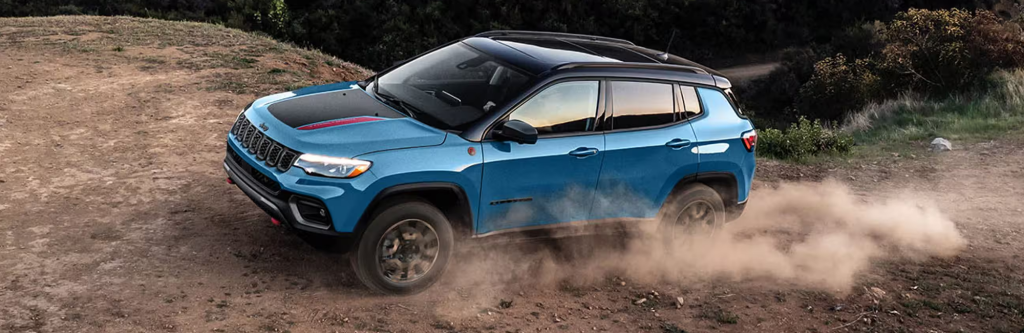
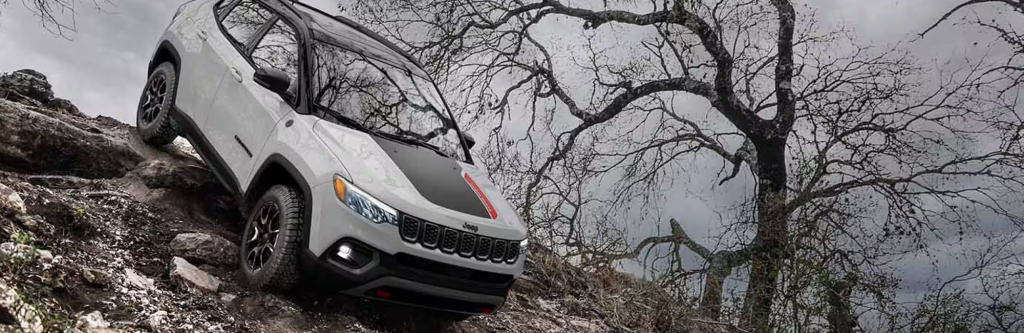
Ground clearance ties all three terms together because it determines how much space exists between the underbody and the trail. On a Jeep Compass, these measurements should guide line choice, speed, and the decision to turn around before bodywork or underbody parts take the hit. The Jeep Compass Trailhawk offers up to 8.6 in. of ground clearance to help clear obstacles on rough trails, ensuring less damage than other trims in its class.
Jeep Compass Off-Road Features That Matter Most
The features that change real trail performance on a Jeep Compass are the Selec-Terrain® traction management system, the 4×4 setup, and tire choice. A useful rule for compact SUVs is that traction control calibration, tire grip, and clearance shape off-road confidence more than raw horsepower on loose surfaces.
Clearance, underbody protection, and available skid plates matter because ruts and washouts can contact vulnerable components before the vehicle reaches its traction limit. That is why a Jeep Compass Limited Altitude trim may feel refined on-road, but for repeated dirt use, the practical advantage comes from protecting the underside and maintaining tire contact over uneven ground.
Towing capacity also deserves restraint because it’s only one part of the picture. The Jeep Compass offers up to 2,000 lbs. of towing capacity when properly equipped, capable of handling small trailers. However, adding trailer weight changes braking distance, departure angle, and recovery planning on soft ground.
Drive Modes: How to Choose the Right Setting
The Selec-Terrain® traction management system uses drive modes to adjust throttle response, shift behavior, and traction control intervention. Auto mode is the default for mixed surfaces, Snow Mode reduces abrupt wheelspin, Sand Mode allows more wheel speed to maintain float, and Mud Mode balances slip control with enough momentum to keep moving.
For Henderson, NC, conditions, use Auto on dry gravel, Snow when cold rain or light winter slush cuts grip, Sand on loose sandy stretches, and Mud on wet clay or shallow ruts. The practical benefit is not magic traction but better calibration, which helps the driver avoid over-throttle inputs that create wheelspin.
Capability Snapshot of the Jeep Compass
The Jeep Compass Trailhawk® is the trim most clearly aimed at dirt road and trail use because its hardware supports traction, clearance, and control. Trail Rated® priorities such as traction, ground clearance, maneuverability, articulation, water fording, and traction control performance describe how a vehicle handles uneven terrain rather than how it performs in a brochure spec sheet. The Jeep Compass Trailhawk® also adds Hill Descent Control, improved approach angle and departure angle measurements, and supports up to 19 in. of water fording in appropriate conditions.
Examples matter here: Falken® WildPeak® all-terrain tires improve bite on loose surfaces, added clearance helps over ruts, and off-road tuning supports steadier progress at low speed. For many drivers, all-terrain tires and better maneuverability will matter more on local trails than small differences in cosmetic equipment.
Pre-Trip Setup: A Simple Reminder Before Hitting the Trails
Before going on your adventure, inspect tire condition, brake feel, fluid levels, exterior lights, and the spare-tire tools. A Jeep Compass can handle a lot with good preparation, but neglected basics create more trail problems than lack of accessories.
Weather planning matters because traction can change within hours after rain. Pack gloves, a flashlight, first aid supplies, drinking water, and a towel, because small comfort and safety items reduce bad decisions when conditions deteriorate.
Use restraint with tire pressure changes. Proper tire pressure plays a major role in traction, ride quality, and durability off road. Lower pressure can improve the contact patch off road, but any reduction should be modest, and you need a reinflation plan before returning to highway speeds.
Tires, Pressure, and Why It Changes Grip
Tread pattern affects how well a tire clears mud and grips gravel, while stronger sidewalls help resist punctures on sharp edges and rutted roads. That means tire construction often influences off-road control more than drivers expect, especially on a compact vehicle where each contact patch does a lot of work.
Lowering pressure can help a tire conform to uneven terrain, but too much reduction raises the risk of sidewall damage or bead issues. The safest approach for most Henderson-area drivers is conservative adjustment paired with a portable inflator.
Recovery and Communication Basics
When taking the Jeep Compass off-road, carry a recovery strap, a tow hook if equipped, work gloves, and shackles only if the vehicle has rated recovery points that match the hardware. Recovery gear is useful only when the attachment points and the method are correct, which is why improvised pulls cause damage.
Offline maps matter because cell coverage can weaken outside town or in wooded areas. A buddy vehicle adds margin because one stuck vehicle is an inconvenience, while one stuck vehicle with no signal can become a long delay. Offline maps are especially useful on remote forest roads and gravel roads where service may be unreliable.
Step-by-Step: Driving Techniques for Common Local Terrain
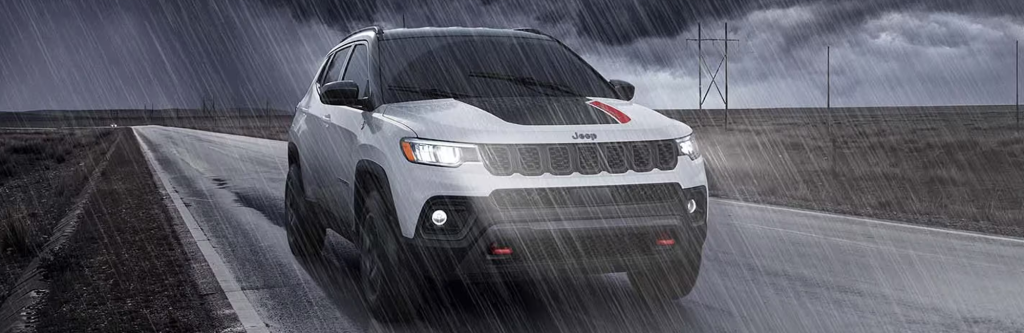
Off-road driving in a Jeep Compass rewards slow hands and patient feet. Smooth throttle, gentle steering, and progressive braking preserve traction better than aggressive inputs, especially where wet clay or marbles of gravel sit on hardpack.
Look farther ahead than you do on pavement and choose a line that avoids deep ruts, exposed rocks, and sharp water-cut edges. If wheelspin continues, a burning smell appears, or traction loss repeats on the same obstacle, stop and reassess before drivetrain heat and underbody contact turn a minor issue into a tow.
Gravel and Forest Roads
On gravel, keep speed moderate and increase following distance because braking effectiveness drops quickly on loose stone. Enter turns with the vehicle settled, since sudden steering can push the front tires wide and reduce control.
Mud and Wet Clay After Rain
Choose the firmest line, which is often the duller and less churned section rather than the shiny track. Controlled momentum helps, but excess throttle digs ruts, packs tread with mud, and makes the next attempt harder.
Shallow Water Crossings and Puddles
Walk the crossing first when safe and legal, checking depth, bottom firmness, and hidden holes. Enter slowly, maintain a steady bow wave, and do not stop mid-crossing because restarting in water raises the chance of wheelspin and water intrusion.
Common Mistakes to Avoid
The most common error in taking the Jeep Compass off-road is overestimating clearance. Washed-out sections can exceed available ground clearance fast, and a compact SUV can contact the underbody before the driver feels the obstacle through the seat. Drivers should always consider ground clearance, approach angle, departure angle, and breakover before attempting an obstacle.
The next mistake is using speed as a substitute for traction. Fast entries increase the chance of bumper strikes, suspension upset, and loss of control, while worn or mismatched tires reduce stability even before the surface gets difficult.
Traction Control Misuse and Excess Wheel Spin
Excess wheelspin overheats components, polishes mud into a slicker surface, and digs holes that trap the tires deeper. The better method is selecting the right mode early, applying measured throttle, and backing off before spin becomes self-defeating.
Skipping the “Turn Around” Decision
A strong trail habit is turning around before the vehicle is committed to an unknown obstacle. If you cannot see the exit, judge the depth, or read the grade, stop and evaluate because solo travel, fading daylight, and recent storms multiply risk.
Choosing the Right Jeep Compass
Drivers who expect regular dirt-road use should prioritize the 4×4 system, capable all-terrain tires, recovery-friendly equipment, and highlighted features designed for trail use. Comfort features matter on daily commutes, but traction and protection determine whether the Jeep Compass stays composed once the pavement ends.
For occasional gravel roads, a street-oriented setup may be enough if the tires are in good condition. For frequent mud, sand, and rough access trails around Henderson, equipment that supports grip and clearance will influence confidence more than appearance packages.
Jeep Compass Trailhawk® vs. Other Trims: What Changes Off Road?
The Jeep Compass Trailhawk adds the most trail-focused equipment and tuning in the lineup. That matters because all-terrain tires, off-road calibration, and added clearance produce a larger real-world difference than small spec changes that do not affect tire contact or underbody risk. Buyers should also compare the Jeep Compass Limited and Jeep Compass Limited Altitude with the Jeep Compass Trailhawk to determine which setup best matches their needs.
Used Jeep Compass Considerations
If you are evaluating a used Jeep Compass for off-roading, inspect the underbody for scrapes, look for uneven tire wear, and listen for suspension noise over bumps. Maintenance history and recall verification matter before trail use because neglected service shows up faster on rough roads than on smooth pavement.
Notes for Drivers: Terrain, Etiquette, and Planning
Use trails and posted access roads only, because land-use rules in and around Henderson protect property, drainage, and trail availability. Trail etiquette also protects your vehicle and fellow trail users: spinning tires in soft sections deepens ruts, increases erosion, and makes the route harder for the next driver.
The weather can change the same route from easy to questionable within a day. That is why route timing, surface awareness, and restraint matter as much as hardware when a Jeep Compass leaves pavement.
A Practical “Before You Leave Town” Plan
Share your route, expected return window, and check-in plan with a friend before heading out. Keep fuel above half, carry rain gear, and pack a towel because changing weather and muddy recoveries are common enough to plan for, not treat as surprises.
If you want to see how the Jeep Compass fits your driving mix, visit us at Crossroads CDJR of Henderson to explore Jeep Compass models in person. A well-matched setup, realistic expectations, and careful technique will do more for off-road confidence than any single spec line.
FAQs
Is the Jeep Compass any good off-road?
Yes, for light to moderate trails, rough roads, gravel, sand, and muddy sections, especially in 4×4 form. The Jeep Compass Trailhawk® adds off-road-focused traction, all-terrain tires, and added clearance for tougher conditions.
Is a 4×4 Jeep Compass good in snow?
A 4×4 Jeep Compass can perform well in snow when paired with proper tires and careful speed control. Use Snow Mode where equipped, leave longer stopping distance, and prioritize winter-rated tires for the strongest grip.
How much can a Jeep Compass tow?
When properly equipped, the Jeep Compass offers up to 2,000 lbs. of towing capacity, making it suitable for small utility trailers, lightweight campers, and outdoor recreation gear. Always check the owner’s manual and vehicle specifications before towing to ensure you stay within recommended limits.
What makes the Jeep Compass Trailhawk® different from other Jeep Compass trims?
The Jeep Compass Trailhawk is the most off-road-focused trim in the lineup. It features Trail Rated® capability, enhanced ground clearance up to 8.6 in., off-road-tuned 4×4 systems, Falken® WildPeak® all-terrain tires, improved approach and departure angles, and features like Hill Descent Control that help on challenging terrain.
Can a Jeep Compass drive through water?
The Jeep Compass Trailhawk is designed to handle shallow water crossing situations and offers up to 19 in. of water fording capability under the right conditions. Drivers should always inspect water depth, current, and bottom conditions before entering any crossing, as conditions can change quickly after rain.
What Can the Jeep Grand Cherokee Handle Off-Road?
Off-Road Driving With A Jeep Grand Cherokee
A lot of drivers want one SUV that can handle weekday pavement, weekend gear, and a muddy access road without drama. For anyone researching Jeep Grand Cherokee off-road use, the key question is not whether the SUV is capable, but how to match its hardware and your technique to the terrain you plan to drive.
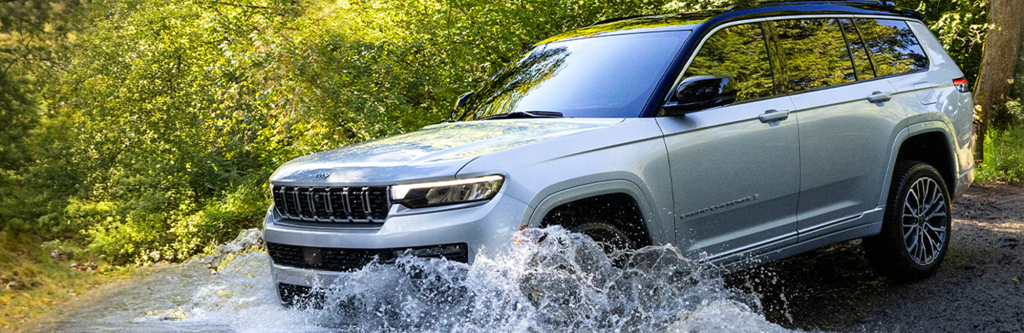
Whether you’re interested in two-row seating or three-row seating, the Jeep Grand Cherokee and Jeep Grand Cherokee L blend family comfort with trail-ready engineering. They’ll be able to conquer gravel roads, forest tracks, and storm-damaged routes better than many midsize SUVs. This guide from Crossroads Chrysler Dodge Jeep Ram of Henderson explains what taking your Jeep Grand Cherokee off-road means around Henderson, NC, how to set up the vehicle, how to drive it safely, and how to avoid the mistakes that strand capable SUVs. Visit us to test-drive the Jeep Grand Cherokee today!
What “Off-Road” Means for a Jeep Grand Cherokee
Off-road use in a Jeep Grand Cherokee usually means loose, uneven, or wet surfaces where traction changes faster than on pavement, not extreme boulder crawling. That distinction matters because Jeep Grand Cherokee’s off-road capability depends on matching trail difficulty to trim, all-terrain tires, clearance, and driver skill, not on assuming every 4×4 can tackle every obstacle.
Around Henderson, NC, common use cases include gravel roads, muddy farm access, rutted forest roads, light sand, and the occasional water crossing after storms. Taking a Jeep Grand Cherokee off-road can cover these conditions well, but approach angle, departure angle, and tire grip determine whether the SUV clears an obstacle cleanly or drags a bumper or underbody.
The Jeep Grand Cherokee’s towing capacity of up to 6,200 lbs. also brings practical strength beyond a 529-mile driving range, which matters for owners hauling small campers, utility trailers, or powersports gear to remote areas. If equipped with D-ring shackles and tow straps, this ensures a more secure haul.
Local Terrain You’ll Likely Encounter Around Henderson
Clay-heavy mud in this part of North Carolina tends to pack into tread blocks fast, which reduces the bite your tires need for forward motion. That is why steady momentum and sensible tire pressure matter more than aggressive throttle, especially once the surface turns slick after rain.
Rutted two-tracks and washouts are also common, and they test line choice more than engine output. Drivers who pay attention to underbody protection and place tires on higher ground reduce the chance of scraping key components or hanging the SUV on a ridge.
Trail planning tools can help estimate route difficulty, seasonal conditions, and access status before you leave home. Good route research lowers risk because many recoveries start with a driver entering a trail that looked easy online but changed after the weather.
Know Your Limits: Driver, Vehicle, and Trail
A conservative turn-around rule when taking the Jeep Grand Cherokee off-road prevents small problems from becoming recovery jobs. If traction, daylight, weather, or fuel margin starts shrinking, turning back early protects both the vehicle and the schedule.
Solo drivers should treat deep mud and unknown water as high-risk obstacles, because recovery options narrow fast when no second vehicle is present. A capable SUV still has limits, and the smartest off-road decision is often the one that avoids needing extraction at all.
Preparing Your Vehicle For Off-Road Trails
The right setup when taking the Jeep Grand Cherokee off-road starts with understanding how it sends power to the ground. Different 4×4 systems can react quickly on loose surfaces, but tires, clearance, and recovery points often shape real-world trail success more than any badge or spec sheet.
Tires deserve the first upgrade budget because they influence grip, braking, puncture resistance, and steering feel on dirt. A quality all-terrain tire with reliable sidewall strength usually improves loose-surface performance more than cosmetic add-ons, especially on mixed-use routes near Henderson, NC.
Protection matters too, because off-road damage often comes from contact underneath, not from dramatic impacts. Drivers who preserve airflow to the cooling system and know where rated recovery points are located make the vehicle easier to drive hard and easier to recover safely.
4×4 Systems and Drive Modes: What to Use and When
Selec-Terrain® Traction Management System changes throttle response, shift behavior, and traction control to match the surface under the tires. That matters because gravel, mud, sand, and rock each reward different power delivery, and the system helps off-roading with a Jeep Grand Cherokee stay composed without constant manual correction.
Use 4WD Auto mode, or High-Range, for changing surfaces and faster gravel sections where traction varies but wheel speed still matters. Use 4WD Low-Range, if equipped, for slow technical sections, steeper climbs, or controlled descents where low-range gearing gives finer throttle control and reduces brake dependence.
Air Suspension and Ground Clearance Basics
The Quadra-Lift® Air Suspension System can raise the Jeep Grand Cherokee for added clearance over ruts, crests, and embedded rocks. Extra ride height improves obstacle clearance and breakover confidence, which matters most on uneven two-tracks where the center of the vehicle can contact first.
Lowering the suspension again for highway travel improves stability and makes loading passengers or cargo easier. The practical habit is simple: raise the Jeep Grand Cherokee off-road obstacles, then return it to a lower setting once the trail ends.
Pre-Trip Checklist Before You Leave Home
Mechanical checks prevent many trail problems that drivers mistakenly attribute to bad luck. Before leaving to have some Jeep Grand Cherokee off-road fun, inspect fluids, brakes, battery health, tire condition, and the spare tire, because minor weaknesses become major issues once you are miles from pavement.
Communication planning matters as much as mechanical prep in low-service areas. Offline maps, a charged phone, weather awareness, and a shared route plan give you a margin of safety that no traction system can replace.
Recovery gear only helps if you know how to use it. A modest kit and basic training usually beat a trunk full of equipment that has never been unpacked.
Tire Pressure, Load, and Cargo Planning
Airing down modestly can improve traction and ride comfort on rough roads by helping the tire conform to the surface. That benefit disappears if you forget to air back up before pavement, since low pressure increases heat and weakens handling at road speeds.
Cargo placement affects stability when the Jeep Grand Cherokee is off-roading more than many drivers expect. Heavy items should sit low and centered, because loose or top-heavy loads shift on inclines and can upset the vehicle when the trail gets off-camber.
Recovery Gear You Should Understand
A recovery strap, soft shackles, traction boards, work gloves, and a portable air compressor form a practical starter kit when taking the Jeep Grand Cherokee off-road. Each item serves a distinct purpose, and traction boards are often the cleanest fix for mild mud because they add grip without the shock loads of a pull.
Never use a hitch ball as a recovery point. Rated points only are the rule because improvised attachment points can fail violently, turning a basic recovery into a serious safety incident.
Step-by-Step: How to Drive a Jeep Grand Cherokee Off-Road
Smooth inputs preserve traction better than aggressive corrections. When taking the Jeep Grand Cherokee off-road, gentle throttle, measured steering, and early braking keep the suspension settled and help the tires maintain grip across changing surfaces.
Line choice protects both tires and the underbody. The goal is not to drive where the trail looks easiest from the seat, but where the vehicle’s width, clearance, and tire placement reduce the chance of contact.
Gravel and Forest Roads
Look well ahead for washboards, potholes, and loose corners, then brake early in a straight line. A steady pace reduces suspension impact and keeps steering authority intact, which is why experienced dirt-road drivers often look calm rather than fast.
Mud and Ruts After Rain
Follow existing ruts only if you have confirmed they are not too deep. If you cannot verify depth, a higher line on the center crown can help keep the differential and floorpan from dragging. The biggest mistake here is wheelspin, because spinning tires polish the mud, dig deeper holes, and remove the little momentum you had.
If off-roading with the Jeep Grand Cherokee starts to lose traction, ease off and reassess. Controlled momentum helps; excessive throttle turns a passable section into a recovery spot.
Shallow Water Crossings
Walk the crossing first when conditions allow, and confirm depth, current, and bottom firmness. Water crossing success depends less on courage than on information, because hidden holes and soft bottoms trap vehicles that had enough clearance on paper.
Enter slowly and maintain a steady bow wave without splashing water toward the intake area. A calm, consistent pace protects the drivetrain better than rushing through and hoping speed solves uncertainty.
Trail Etiquette and Legal Basics
When gearing up to take the Jeep Grand Cherokee off-road, stay on designated motorized routes, yield where appropriate, and pack out all trash. Trail etiquette is not cosmetic, it is the difference between sustainable recreation and route closures.
Keep noise and speed reasonable near neighborhoods, trailheads, and shared-use areas. A respectful pace protects other users and lowers the chance of conflict with nearby residents.
Off-Roading Adventures Await
A Jeep Grand Cherokee performs best off pavement when the driver combines the right tires, the right mode, and disciplined technique. Speed is not the source of capability; traction, clearance, and judgment are. Most trail problems are preventable with pre-trip checks, modest airing down, route research, and a clear turnaround point.
For drivers comparing trims or learning which features fit local use, our team at Crossroads CDJR of Henderson sees the same pattern repeatedly: owners who prepare to take their Jeep Grand Cherokee off-road enjoy more of the lifestyle side of off-roading, from lake access to quiet forest roads, with fewer repairs and fewer recoveries. Discover the best Jeep Grand Cherokee model for off-road today by visiting us for a test drive!
FAQs
Is the Jeep Grand Cherokee good for off-roading?
Yes, especially with 4×4 and the right tires. It handles gravel, ruts, mud, and moderate trails well, but capability depends on trim, tires, and driver technique.
Does the Jeep Grand Cherokee have 4WD or AWD?
Many Jeep Grand Cherokee models offer 4×4 systems, often described as 4WD. Availability depends on trim and configuration, so confirm the drivetrain on the specific vehicle.
What is the best drive mode for off-road in a Jeep Grand Cherokee?
Use the Selec-Terrain® Traction Management System that matches the surface, such as mud/sand or rock, if equipped. For slow technical driving, 4WD Low-Range is the better choice when your model includes it.
How do I avoid getting stuck in mud with a Jeep Grand Cherokee?
Use appropriate tires, limit wheelspin, keep steady momentum, and avoid deep ruts when possible. If traction drops, stop early and use traction boards before the vehicle digs down.
Can I take a Jeep Grand Cherokee on trails near Henderson, NC?
Yes, if the route is legal and open to motorized travel. Check access rules, recent weather, and trail difficulty before heading out.
Off-Roading With A Jeep Wrangler: Your Guide To Adventure
A lot of drivers start with the same question: how capable is a Jeep Wrangler once the pavement ends and the route turns muddy, uneven, or washed out? For anyone researching Jeep Wrangler off-road use, the useful answer is not hype but matching the vehicle’s design to real terrain, driving habits, and recovery planning. This guide from Crossroads Chrysler Dodge Jeep Ram of Henderson explains what taking your Jeep Wrangler off-road means in practical terms, how to prepare, which features matter most, and how to drive with more control on mixed trails near Henderson, NC, and similar areas.
We’ll explain that Jeep Wrangler off-road confidence comes from understanding limits before testing models like the Jeep Wrangler Rubicon and the Jeep Wrangler Willys. Schedule a test drive at our Jeep dealer in Henderson, NC, to show how each setup fits your trail plans today!
What “Off-Road” Means for a Jeep Wrangler
Off-road driving covers more than rock crawling. When taking a Jeep Wrangler off-road, it can mean gravel roads, rutted forest tracks, clay mud, sand, short steep grades, and a cautious water crossing, each of which stresses traction, clearance, and driver judgment in different ways.
Around Henderson, NC, mixed forest roads and wet seasons often create slick surfaces where clay behaves more like grease than dirt. That matters because even a capable four-wheel drive system cannot create grip on a surface that has turned polished and saturated, so tire choice and throttle control become as important as hardware.
The Jeep Wrangler platform is suited to this work because its design starts with off-road geometry and drivetrain capability. A useful example is the combination of ground clearance, a strong departure angle, and available hardware built to handle uneven terrain without constant bumper or underbody contact. The Jeep Wrangler’s off-road capabilities still depend on where you drive and how you drive. Staying in approved off-road areas protects private property, preserves public land access, and prevents trail damage that can close routes for everyone.
Know Your Limits: Vehicle, Driver, and Trail
A trim name does not guarantee success on a difficult trail. Real Jeep Wrangler off-road capability comes from the full combination of tires, ground conditions, driver skill, and route selection. It is why a carefully driven Jeep Wrangler on good all-terrain tires often outperforms a poorly driven higher trim.
Turning around early is a skill, not a failure. If you cannot reverse safely, cannot see a recovery option, or do not know what is beyond the next ledge or mud hole, the smart move is to stop before the trail makes the decision for you.
Pre-Trip Checklist: Get Your Jeep Wrangler Ready
A short inspection before leaving home to take your Jeep Wrangler off-road prevents many trail problems that look dramatic but start as routine maintenance issues. Be sure to check:
- Fluids
- Belts
- Hoses
- Battery condition
- Brake pad life
- Steering play
These are important because off-road loads amplify weak components that might feel acceptable during a normal commute.
Tires deserve extra attention because they are your first traction system. Inspect tread depth, confirm matching tire sizes, and look for sidewall cuts or bulges, since uneven or damaged tires can upset handling and reduce control in loose terrain.
Pack essentials that solve common trail problems without taking much space. Water, a first-aid kit, flashlight, gloves, a basic tool kit, and a full-size spare support both comfort and safety when a short outing becomes a longer recovery.
Communication planning belongs on the Jeep Wrangler off-road checklist too. Tell someone your route and expected return time, and keep a paper map as backup because cell coverage can disappear long before the trail becomes difficult.

Recovery Gear to Carry, Even on Easy Trails
Recovery points matter more than many new drivers realize when they take their Jeep Wrangler off road. Use rated tow hooks or other rated recovery points, and never attach a strap to a hitch ball because that setup can fail violently under load.
A Trail Rated badge signals that a Jeep Wrangler has passed specific capability tests, but it does not replace recovery equipment. A kinetic recovery rope, soft shackles, and a tire pressure gauge are compact tools that address the most common stuck scenarios without requiring a full winch setup.
Tech Setup for the Trail
Offline maps are one of the easiest upgrades to your Jeep Wrangler off-road trail routine. Download route areas before you lose signal, because navigation errors often create more risk than the obstacle that worried you in the first place.
Trail apps also help confirm legal access and difficulty ratings. A route labeled easy in dry weather can become a different trail after heavy rain, and current user reports often reveal closures, washouts, or deep mud sections.
Feature Considerations for Off-Road Capability
The Trail Rated badge indicates that a Jeep Wrangler has been evaluated in areas such as traction, water fording, articulation, maneuverability, and ground clearance. It does not mean every trim performs the same on the same trail, because tires, axle hardware, gearing, and bumper design still shape real-world results.
Core capability starts with the Jeep Wrangler’s solid front axle and solid rear axle layout. That architecture supports durability and articulation on uneven terrain, which is why the platform remains credible in conditions that expose weaknesses in softer road-focused suspensions.
Bumper design affects clearance more than many buyers expect. A steel front bumper can improve durability and obstacle confidence, while approach angle and bumper shape determine whether the vehicle climbs over a ledge cleanly or contacts it first.
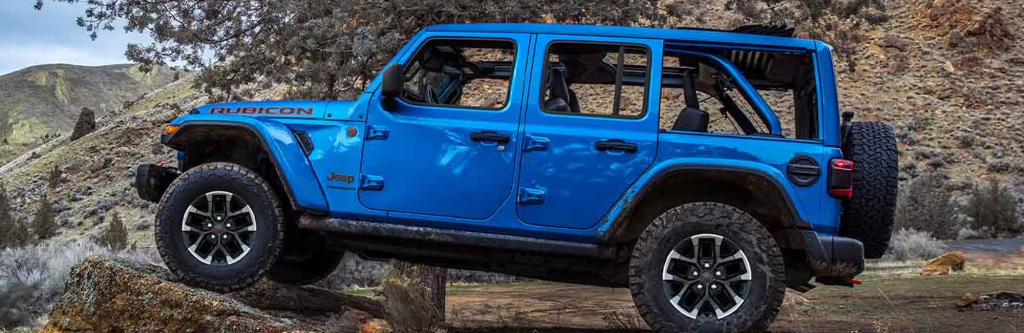
For many drivers considering Jeep Wrangler off-roading, the practical comparison is between the Jeep Wrangler Willys and Jeep Wrangler Rubicon.
Jeep Wrangler Willys: Trail-Ready Capability with Everyday Versatility
Taking a Jeep Wrangler Willys off-road gives you a balance between authentic off-road performance and daily usability. Designed for drivers who want to explore beyond the pavement without going fully extreme, the Jeep Wrangler Willys delivers key trail-focused upgrades right from the factory.
Equipped with aggressive all-terrain or mud-terrain tires and a rear limited-slip differential, it improves traction across loose surfaces like dirt, sand, and gravel. Its rugged suspension and proven 4×4 system provide confident control on uneven terrain, while maintaining a smoother on-road feel compared to more specialized trims.
This makes the Jeep Wrangler Willys an ideal choice for weekend adventurers—capable of handling trails, forest roads, and light rock obstacles—while still serving as a comfortable daily driver. It offers a strong foundation for off-road exploration without the added complexity or cost of heavy-duty hardware.
Jeep Wrangler Rubicon: Engineered for Extreme Off-Road Dominance
The Jeep Wrangler Rubicon is purpose-built for serious off-road enthusiasts who demand maximum capability in challenging environments. It’s engineered with heavy-duty components and advanced 4×4 systems that allow it to tackle rock crawling, steep climbs, and technical terrain with confidence.
At the core of the Jeep Wrangler Rubicon’s advantage are its front and rear locking differentials, which distribute power evenly to all wheels for superior traction in low-grip situations. A Rock-Trac® 4×4 system with a low gear ratio enhances control at slow speeds, while the electronic sway bar disconnect increases wheel articulation—helping the vehicle maintain contact with uneven surfaces.
Additional upgrades like heavy-duty Dana® 44 axles and increased ground clearance further reinforce its trail dominance and make the Jeep Wrangler Rubicon off-road the most capable Jeep Wrangler for extreme off-road conditions. It’s built not just to handle the trail—but to conquer it.
Jeep Wrangler Capability Highlights to Know
The available WARN® winch with an 8,000-lb. winch capacity adds controlled self-recovery or assisted recovery capability. That matters because a winch is less about dramatic rescues and more about reducing risk when traction disappears on an incline or in deep mud.
The Jeep Wrangler also has the front radar sensor near the top of the windshield area rather than low in the bumper. That design choice preserves off-road functionality by reducing the chance that trail obstacles or aftermarket bumper changes interfere with a key driver-assistance component.
How to Use Jeep Wrangler 4×4 Systems Correctly
It’s important to understand the Jeep Wrangler off-road mechanics when adventuring.
The 2H mode (Two-Wheel Drive, High Range) is for normal dry-road driving because it powers the rear wheels and avoids unnecessary drivetrain binding.
The 4H mode (Four-Wheel Drive, High Range) is for loose or slippery surfaces such as gravel, snow, or mud, where extra traction helps, but speeds remain moderate.
The 4L mode (Four-Wheel Drive, Low Range) is for slow technical work, not speed. Low range multiplies torque and improves control on climbs, descents, rocks, and deep ruts, which is why experienced drivers use it to reduce drama rather than increase aggression.
Avoid using part-time four-wheel drive on dry pavement. Driveline binding can build when the surface does not allow tire slip, and that mechanical stress is one of the most common preventable mistakes new owners make.
Traction Aids and Off-Road Features to Understand
A locking differential forces both wheels on an axle to turn together, which helps during Jeep Wrangler off-roading when one tire loses grip. The tradeoff is reduced steering ease in some conditions, so lockers help most when used deliberately on loose terrain rather than left engaged without a plan.
A sway bar disconnect, where equipped, allows more articulation at low speed by helping the suspension follow uneven ground. Reconnect it for road driving, because the same flexibility that helps on the trail reduces the body control you want on pavement.
Step-by-Step: Driving Common Obstacles Near Henderson, NC
Controlled Jeep Wrangler off-road driving starts with visibility and pace. Use a spotter when sightlines are limited, agree on hand signals before moving, and keep speed low enough that each tire placement is a choice rather than a reaction.
Steady throttle protects both the trail and the vehicle. Slow, smooth inputs reduce wheelspin, protect sidewalls, and lower the chance of sliding into a rut wall or high-centering on a crown.
Mud and Ruts
On muddy trails, existing mud ruts are often the least damaging path if they are not too deep for your clearance. Driving around them widens the trail and increases erosion, which is why trail discipline is part of vehicle preservation as much as land stewardship.
If the Jeep Wrangler starts sinking, stop before the tires dig holes. Spinning deeper into mud usually turns a simple pull into a longer recovery and increases the chance of packing mud into brakes and suspension components.
Water Crossings
A water crossing when Jeep Wrangler off-roading demands inspection before commitment. If safe, check depth and bottom firmness on foot, because hidden holes and soft bottoms strand more vehicles than water itself.
Cross slowly and maintain a light bow wave ahead of the bumper. That technique helps keep water levels stable around the engine bay, and drying the brakes afterward restores a predictable stopping feel.
Steep Climbs and Descents
Use 4L on steep climbs because low range improves torque control rather than top speed. Controlled throttle and minimal steering input keep the vehicle settled, which matters more than momentum on short, uneven grades.
On descents, choose low gear and let engine braking manage speed. Riding the brakes builds heat and can reduce traction, while a slow mechanical descent keeps the Jeep Wrangler more stable on slick surfaces.
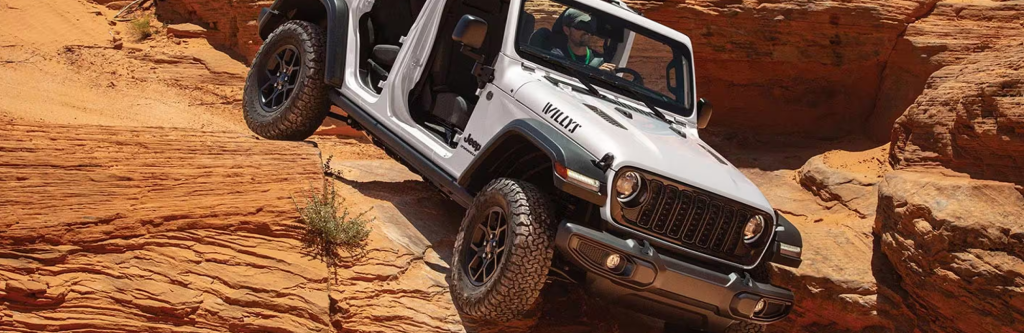
Common Mistakes Some Off-Road Drivers Make
One of the biggest errors when taking the Jeep Wrangler off-road is choosing the wrong 4×4 mode for the surface. Good 4×4 traction depends on matching 2H, 4H, or 4L to conditions, and staying in four-wheel drive on dry pavement can create avoidable driveline stress.
Another mistake is over-throttling when traction drops. Wheelspin often reduces forward progress, tears up the trail, and digs the vehicle deeper, while a pause and reassessment usually preserve more options.
Many new drivers also skip recovery planning. No rated points, no communication plan, and no air source can turn a routine outing into a long wait, especially in areas where another vehicle may not pass for hours.
High-centering is another common lesson because drivers focus on tire placement but forget the center of the vehicle. Reading crests and checking angles before committing prevents underbody contact that stops progress even when the tires still have grip.
Tires, Airing Down, and Ground Clearance Basics
Tires are often the single biggest capability upgrade on when taking the Jeep Wrangler off-road because they influence traction, puncture resistance, and ride quality at the same time. A better tread pattern and stronger sidewall can change trail performance more than many cosmetic accessories ever will. All-terrain tires are the practical choice for mixed use because they balance road comfort with off-road traction. Mud-terrain tires work better in frequent mud but are often louder and less settled on pavement, so the best tire depends on where the vehicle spends most of its miles.
Airing down improves grip by enlarging the tire’s contact patch and helping the tire conform to obstacles. The key is knowing safe pressures for your tire and load, because too little pressure can risk bead loss or sidewall damage.
Ground clearance works with geometry, not by itself. Approach angle, breakover angle, and departure angle determine whether the Jeep Wrangler clears an obstacle cleanly or drags its bumper or belly at the transition point.
Airing Down: A Safe, Simple Process
Start conservatively and adjust based on traction, ride feel, and visible sidewall flex. A quality gauge gives repeatable readings, and an air compressor is essential because reinflating before pavement protects tire wear, braking stability, and steering response.
Reinflate before highway speeds every time. Low pressures help off road, but on pavement they increase heat buildup and reduce handling precision, which turns a trail advantage into a road liability.
Ready to Hit the Trails?
A Jeep Wrangler earns its off-road reputation through a combination of four-wheel drive systems, axle design, clearance, and a chassis built for uneven terrain, but capability still depends on preparation and driver judgment. The most effective setup is the one that matches your real mix of commuting, weekend exploring, mud, grades, and occasional recovery needs.
For beginners, a Jeep Wrangler can handle many entry-level trails with smart tire choices, careful 4×4 use, and a basic recovery kit. For drivers comparing the Jeep Wrangler Willys and Jeep Wrangler Rubicon, the difference is less about image and more about how often you expect to face technical terrain that rewards added traction hardware.
If you want to experience how a Jeep Wrangler fits your off-road plans, visiting Crossroads CDJR of Henderson for a closer look and a test drive can help translate specs into real-world confidence. A thoughtful purchase paired with responsible trail habits gives the Jeep lifestyle its best form: capable travel, open-air freedom, and the confidence to keep exploring.
FAQs
Can a Jeep Wrangler handle beginner off-road trails?
Yes. A Jeep Wrangler is well suited for beginner trails because it combines four-wheel drive, useful ground clearance, and durable construction in stock form.
Do I need special tires or equipment before going off-road?
Not always, but better tires make a major difference. All-terrain tires, tow hooks, and basic recovery gear improve safety and traction on uneven or muddy routes.
What’s the difference between the Jeep Wrangler Willys and Jeep Wrangler Rubicon trims for off-roading?
The Jeep Wrangler Willys is a strong entry point with trail-friendly upgrades for mixed use. The Jeep Wrangler Rubicon adds more serious hardware for technical terrain, including stronger traction-focused features and lower-speed control.
How should I prepare my Jeep Wrangler before hitting the trail?
Check tire pressure, fluids, brakes, battery condition, and recovery points before leaving. Bring water, a spare, a first-aid kit, navigation backup, and gear to air down and reinflate.
Is it safe to go off-roading alone in a Jeep Wrangler?
It is safer to travel with another vehicle when possible. If you go alone, share your route, carry recovery gear, and plan for limited cell service before you leave.
Rugged Truck Face-Off: Ram 1500 vs. Chevy Silverado 1500
When it comes to full-size pickup trucks, performance and reliability are everything. The Ram 1500 vs. Chevy Silverado 1500 are two of the most popular vehicles in the full-size pickup truck segment. Each truck is available in multiple models and vehicle configurations, allowing buyers to choose the best fit for their needs. While the Ram 1500 vs. Chevy Silverado 1500 bring a strong showing in capability and technology, the Ram clearly edges out its rival in key areas, including towing capacity, cabin luxury, powertrain innovation, and long-term dependability. If you’re in the market for a truck that blends muscle with modern refinement, the Ram 1500 is the one to beat. And for those ready to see it in action, Crossroads Chrysler Dodge Jeep Ram of Henderson is the place to schedule your test drive today.
Muscle Where It Matters
Let’s start with the numbers. The Ram 1500 vs. Chevy Silverado 1500 offer impressive specs, with a range of engine options, towing, and payload capacities that set them apart in the segment. Taking a look at the Ram 1500 vs. Chevy Silverado 1500 towing capacity, the Chevy boasts a maximum haul of 13,300 lbs., which is achievable with the available Duramax® 3.0L Turbo-Diesel engine. The Ram 1500, by contrast, offers up to 11,550 lbs. of maximum trailering capacity with its available 3.0L Hurricane engine—a close second, without the diesel requirement. Although Ram 1500 vs. Chevy Silverado 1500 distinguishes a clear winner in raw capacity, keep in mind the Chevy only tows more when equipped with a diesel engine, while the Ram tows nearly as much without special fuel requirements Speaking of available engine specs between the Ram 1500 vs. Chevy Silverado 1500, Chevy offers up to 420 horsepower and 495 lb.-ft. of torque depending on engine choice, while the Ram churns out a robust available 540-horsepower and 521 lb.-ft. of torque. Payload capacity is also a key factor for Ram 1500 vs. Chevy Silverado 1500 reliability, with the Chevy offering up to 2,260 lbs. and the Ram outperforming with up to 2,370 lbs.
First-Class Comfort on Every Drive
The Ram 1500 vs. Chevy Silverado 1500 both aim to pamper drivers, but the Ram’s cabin is a class above, offering what may be the most luxurious interior ever fitted to a pickup. In higher trims, the Ram 1500 approaches the level of a luxury vehicle, featuring upscale touches like leather upholstery and a suede headliner. By contrast, the Chevy Silverado 1500 has leather seating surfaces with exclusive custom perforation and stitching pattern and authentic open-pore wood trim. Crew cab versions are available for both trucks, providing maximum interior space and versatility for passengers.
With a 14.5-in. Uconnect® 5 touchscreen, a 12-in. Driver Information Digital Cluster Display, and a 10.25-in. Passenger Interactive Display, the Ram 1500 delivers a more immersive and intuitive tech experience than the Chevy Silverado 1500’s available 13.4-in. infotainment screen and 12.3-in. gauge cluster. Both the Ram 1500 vs. Chevy Silverado 1500 offer Apple CarPlay® and Android Auto™, but Ram adds a reconfigurable Head-Up Display and a more advanced infotainment layout that’s both functional and stylish.
Safety & Technology: Peace of Mind Standard
When it comes to safety, the Ram 1500 vs. Chevy Silverado 1500 ensure everyone’s safety wherever you go. The Ram leaves nothing to chance, however, boasting over 100 standard and available safety features, such as Electronic Stability Control with Anti-Rollover, Forward Collision Mitigation, Blind Spot Warning, and Hands-Free Active Driving Assist. These numerous features give you confidence whether you’re hauling a trailer or cruising the highway. Additionally, advanced driver aids like Adaptive Cruise Control and Cross Traffic Alert are available on the Ram 1500, further enhancing safety and awareness in various driving situations. The Chevy Silverado 1500 utilizes the Chevy Safety Assist suite as its standard, but lacks the depth and range of driver-assistance features found on the Ram. Intersection Collision Assist and available semi-autonomous driving are advantages Chevy just doesn’t match.
Experience the Clear Winner Today
When comparing the Ram 1500 vs. Chevy Silverado 1500, the choice becomes clear. With proficient towing performance, a more luxurious and tech-savvy interior, advanced safety features, and a proven reputation for reliability, the Ram 1500 doesn’t just lead the pack, it defines it. Ready to take the next step? Visit Crossroads CDJR of Henderson for a test drive to see for yourself why it’s the best full-size truck for drivers who demand more from every mile.

The All-Electric SUV Showdown
In the battle of all-electric SUVs, the Jeep Wagoneer S vs. Tesla Model Y comparison is turning heads—and for good reason. The Jeep Wagoneer S introduces an electrified chapter of legendary Jeep performance, and it’s already making waves by going head-to-head with longtime EV standout, the Tesla Model Y. This Jeep vs. Tesla comparison from Crossroads Chrysler Dodge Jeep Ram of Henderson dives into what truly separates these two vehicles—and why the Jeep Wagoneer S leads the charge when it comes to power, presence, and premium adventure.
Bold Design Meets Electric Power
One glance at the Jeep Wagoneer S and it’s clear: this SUV means business. With a sleek, aerodynamic design inspired by adventure, it still retains the iconic seven-slot grille—now reimagined with a bold LED-illuminated treatment that makes a statement day or night. In comparison, the Tesla Model Y leans into minimalist curves and a subdued silhouette that prioritizes efficiency over personality. When comparing each car, the Jeep Wagoneer S EV stands out with a more rugged, commanding appearance, while the Tesla car offers a softer, more understated look.
When you compare the Jeep Wagoneer S vs. Tesla Model Y in terms of performance, the Jeep Wagoneer S surges ahead. The Tesla Model Y Performance trim offers enhanced speed and power, but the Jeep Wagoneer S generates an incredible 600 horsepower and 617 lb.-ft. of torque—more than enough to rocket from 0 to 60 MPH in just 3.4 seconds. That’s faster than many sports cars, and even quicker than the Tesla Model Y Performance trim. The raw power of the Jeep Wagoneer S is evident in its superior horsepower and acceleration, and its top speed also surpasses that of the Tesla Model Y. Some Tesla models have low horsepower compared to the Jeep Wagoneer S, and in these key performance aspects, Tesla falls short.
All-Electric 4×4 Capability
Jeep brings its off-road DNA into the electric future. The Jeep Wagoneer S is the first global battery electric vehicle from the Jeep brand and comes with standard all-wheel drive, tailored to conquer tough terrain and weather conditions alike. Its high ground clearance is a great asset, providing the ground clearance needed to tackle a challenging rocky trail or rocky terrain with confidence. Tesla’s Model Y features available dual-motor all-wheel drive, but it lacks the rugged engineering and is more suited for road-bound travel and paved roads. The base Tesla Model Y also offers a rear-wheel drive configuration, focusing on efficiency for rear wheels rather than off-road prowess.
Whether you’re climbing elevation or navigating slick back roads, Jeep’s off-road heritage shines. The Jeep Wagoneer S features the Jeep Selec-Terrain® Traction Management System with Auto, Sport, ECO, Snow, and Sand modes for unmatched adaptability, enhancing terrain maneuverability and ensuring the vehicle is ready for any path ahead. Tesla simply can’t compete when the road turns rough. While the Tesla Model Y delivers strong acceleration navigating on ramps, its lower ground clearance limits its capability beyond road-bound travel.
The Jeep Wagoneer S offers a comprehensive suite of off-road and safety features, setting it apart from the competition.
Range & Charging
Range is a key consideration in the Jeep Wagoneer S vs. Tesla Model Y showdown. The Jeep Wagoneer S targets an estimated range of 294 miles on a full charge, slightly below the Tesla Model Y, which offers 327-357 miles of range depending on trim. The long range model of the Tesla Model Y is especially notable for its extended driving distance and all-wheel drive capability. In terms of fuel economy, the Tesla Model Y boasts a higher EPA MPGe rating, making it more efficient than the Jeep Wagoneer S As far as charging speed, the Jeep Wagoneer S pulls ahead, boasting just 23 minutes to get from 20-80%, while the Tesla claims to add 182 miles in 15 minutes—just over 50% of the total range. Additionally, the Tesla Model Y is a lot cheaper than the Jeep Wagoneer S. With the Jeep Wagoneer S, drivers receive access to the Jeep 4xe Charging Network, with thousands of charging locations across the country—and a Level 2 home charging station included with purchase for added convenience.
Interior Luxury & Technology
Inside, the Jeep Wagoneer S defines upscale electric driving. It features a fully digital cockpit with over 45 inches of total screen space, including a 12.3-inch digital cluster, a 12.3-inch center touchscreen, and a 10.25-inch interactive passenger display. This advanced layout supports the latest Uconnect® 5 system, Alexa Built-in, and wireless Apple CarPlay® and Android Auto™. The Jeep Wagoneer S also stands out for its impressive interior space, offering generous room for passengers and cargo compared to other EVs in its class.
Comfort features in the Jeep Wagoneer S include available leather-trimmed seating, ambient lighting designed to reflect the horizon at dusk, a heated steering wheel, and remote engine start for added convenience. Advanced safety and convenience technologies include a head-up display, enhancing driver awareness—features not found in the Tesla Model Y.
The Tesla Model Y, on the other hand, continues with a simplified 15.4-inch central screen and no instrument cluster, which can be a learning curve for many drivers. While clean and futuristic, Tesla’s bare interior design lacks the warmth, comfort, and craftsmanship you’ll find in the Jeep Wagoneer S.
Safety Systems You Can Count On
Both vehicles include a strong suite of safety features, but the Jeep Wagoneer S elevates confidence with over 170 standard safety and security features—surpassing Tesla’s offerings. The Jeep Wagoneer S stands out with safety features such as a 360-degree surround view camera, rear safety technologies including rear side airbags and sensors, and parking sensors for enhanced convenience and protection. Advanced systems like brake assist and Adaptive Cruise Control are also included as standard, making the Jeep Wagoneer S the clear winner in safety.
Tesla’s Model Y includes standard safety systems like Active Emergency Braking, Lane Departure Avoidance, and Forward Collision Warning, but it offers fewer safety features overall. Unlike the Jeep Wagoneer S, the Tesla Model Y lacks standard surround view cameras, parking sensors, and comprehensive rear safety coverage, making Jeep’s safety tech suite the superior choice that families and daily drivers will appreciate.
Make the Powerful Choice Today
When it comes to Jeep Wagoneer S vs. Tesla Model Y, the Jeep Wagoneer S doesn’t just compete—it dominates. With unmatched horsepower, legendary Jeep 4×4 capability, upscale interior technology, and a design that honors its roots while embracing the electric future, the Jeep Wagoneer S is redefining what an electric SUV can be.
Experience the thrill of all-electric power with the confidence of Jeep heritage. Visit Crossroads CDJR of Henderson today to learn more about the Jeep Wagoneer S and see how it stacks up against the Tesla Model Y. Schedule your test drive now and electrify your next adventure.

Find Your Dream Performance EV
When comparing the Dodge Charger Daytona vs. Tesla Model 3, you’re looking at two distinctly different takes on the future of high-performance electric vehicles. One comes from a brand that defines American muscle, and the other from a company that has revolutionized the EV landscape. This article discusses the differences between the Dodge Charger Daytona and the Tesla Model 3.
In this Dodge Charger Daytona vs. Tesla Model 3 Performance showdown from Crossroads Chrysler Dodge Jeep Ram of Henderson, we break down how Dodge’s first electric muscle car is redefining raw power, heritage, and driving excitement—while the Tesla Model 3 offers a more refined, minimalist approach. We’ll be analyzing performance, design, and value to help you make an informed decision. Let’s dive into the details and explore the unique qualities and driving experiences each EV has to offer.
Performance With Attitude
The Dodge Charger Daytona vs. Tesla Model 3 performance comparison starts where every car enthusiast wants to begin—under the (virtual) hood. Both vehicles were tested on acceleration, braking, and handling to provide a comprehensive performance evaluation.
The Dodge Charger Daytona delivers unmistakable muscle with electrified fury. The top-level powertrain boasts a 400V system architecture and uses more powerful motors to overcome its greater weight, resulting in exhilarating acceleration and torque that Dodge fans have come to expect. Energy consumption and management also play a significant role in acceleration and overall efficiency, with the Dodge Charger Daytona’s design focusing on delivering high performance while managing energy demands.
The Tesla Model 3 Performance, on the other hand, brings solid speed and impressive 0–60 times—clocking in as low as 2.8 seconds. The Tesla’s lighter weight and efficient energy use allow it to accelerate and handle with greater agility, significantly differentiating it from the heavier Dodge. However, it lacks the visceral experience that Dodge engineers baked into every inch of the Dodge Charger Daytona. Tesla’s design philosophy is rooted in silence and efficiency, while Dodge leans into drama, power, and muscle legacy. In the Dodge Charger Daytona vs. Tesla Model 3 Performance debate, Dodge offers more than speed—it offers soul.
Design That Commands Respect
In terms of styling, the Dodge Charger Daytona doesn’t whisper—it roars. It keeps the aggressive stance and bold lines of its gas-powered predecessors while reimagining them for the EV era. A nod to its racing history, the Dodge Charger Daytona’s R-Wing front aerodynamic pass-through significantly reduces lift and drag while preserving its iconic shape. Every angle is designed to intimidate, with heritage-inspired lighting and muscular proportions that scream performance. The Dodge Charger Daytona features two-door and four-door configurations, emphasizing its classic muscle car appeal, and even expanding into practicality and accessibility for families.
The Tesla Model 3, by contrast, sports a sleeker, more conservative look. With its minimalistic curves and smooth surfaces, the Tesla Model 3 is built for aerodynamic efficiency—but lacks the aggressive personality that muscle car fans crave. Its interior features comfortable synthetic seats, providing a modern and supportive ride, while the Dodge Charger Daytona often comes with cloth or sport seats that focus on performance aesthetics.
When choosing between the Dodge Charger Daytona vs. Tesla Model 3, design enthusiasts looking for street presence and attitude will lean heavily toward the Dodge Charger Daytona, but those prioritizing practicality and everyday usability may prefer the Tesla Model 3.
Interior & Tech: Driver-Focused vs. Minimalist
Step inside the Dodge Charger Daytona, and you’re greeted with a performance cockpit that’s equal parts futuristic and familiar. A driver-centric 12.3-inch center display and available 16-inch instrument cluster immerse you in the experience, while available performance pages let you monitor G-force, track times, and more. Ambient lighting, sculpted seating, and classic Dodge details complete the high-octane vibe.
In the Tesla Model 3, you’ll find a minimalist interior dominated by a single 15.4-inch touchscreen. It’s clean and modern, with most functions controlled digitally. While the interface is intuitive, it doesn’t offer the tactile engagement or racing-inspired atmosphere you’ll find in the Dodge Charger Daytona. For enthusiasts who want to feel like they’re in the cockpit of something powerful, the Dodge wins this round.
Driving Dynamics & Engagement
EVs are known for straight-line speed, but Dodge Charger Daytona vs. Tesla Model 3 comparisons must also factor in driving feel. Dodge has engineered the Dodge Charger Daytona with performance driving in mind. With multiple drive modes like Drift and Donut Mode—yes, Donut Mode—it’s built to entertain. The PowerShot boost feature gives you extra torque on demand for jaw-dropping bursts of acceleration.
The Tesla Model 3 handles corners with poise thanks to its low center of gravity and well-balanced chassis. But when it comes to driving excitement and engagement, the Tesla Model 3 leans toward composure rather than thrill. Dodge delivers the drama, the feedback, and the excitement—everything performance drivers crave.
Innovation Meets Heritage
What makes the Dodge Charger Daytona vs. Tesla Model 3 comparison so compelling is how each brand defines innovation. Both manufacturers are adapting to changes in the automotive industry and responding to shifting market dynamics, moving the industry forward toward electrification. Tesla pioneered the mass-market EV with an emphasis on sustainability and cutting-edge automation, pushing the boundaries of performance and design. Meanwhile, Dodge’s attempt to electrify the Dodge Charger Daytona is a deliberate effort to preserve its muscle car legacy while embracing modern innovation, showing how essential innovation is for staying competitive. This comparison is highly relevant in today’s market, as it highlights the advantages each vehicle brings to the table and the lessons learned from their different approaches.
The Dodge Charger Daytona isn’t just a new chapter—it’s a bold rewrite of what muscle cars can be. From the Fratzonic Chambered Exhaust System to various racing options like Launch Control, it preserves the emotional elements of driving in a segment often defined by silence and sameness.
Which EV Reigns Supreme?
The Tesla Model 3 excels in efficiency, range, and quiet sophistication, offering a more affordable base price point and better value for buyers seeking an accessible electric vehicle. In contrast, the Dodge Charger Daytona—the world’s first electric muscle car—redefines what an electric car can feel like, catering to enthusiasts who prioritize high performance, bold design, and a connection to driving heritage.
When comparing these two vehicles, both cars cater to different consumer preferences: the Tesla Model 3 is ideal for those seeking affordability and everyday practicality, while the Dodge Charger Daytona appeals to those who want a unique, thrilling EV experience. According to Edmunds and recent news, the two EVs each have distinct strengths, and a head-to-head video comparison highlights their performance differences.
For more details, visit our dealership website to explore features, pricing, and see which of these two vehicles offers the better value for your needs. In the battle of Dodge Charger Daytona vs. Tesla Model 3, the Dodge doesn’t just aim to compete—it aims to dominate. Your next ride doesn’t have to whisper. It can roar.
Ram 2500 vs. Chevy Silverado 2500: Testing The Strength Of Heavy-Duty Trucks
If you’re in the market for a heavy-duty truck that blends muscle, innovation, and refinement, you’re likely comparing top contenders like the Ram 2500 vs. Chevy Silverado 2500. While both bring impressive capability to the job site and the highway, the Ram 2500 pulls ahead with class-exclusive features, unmatched towing strength, and a cabin that feels more like a premium SUV than a workhorse. At Crossroads Chrysler Dodge Jeep Ram of Henderson, we’ve put together a comprehensive blog comparing the Ram 2500 vs. Chevy Silverado 2500 to see which one suits your needs. Afterwards, come visit our dealership to experience why the Ram 2500 continues to be the top choice for truck owners who demand more.
Design That Works as Hard as You Do
Taking a look at the designs for the Ram 2500 vs. Chevy Silverado 2500, there are striking differences that make them stand out. With a bold, sculpted exterior and an aggressive stance, the Ram 2500 turns heads and means business. This includes robust bumpers that add both style and functional protection, while the available class-exclusive RamBox® Cargo Management System and optional Mopar® Bed Step deliver real-world utility that the Chevy simply can’t match. The Ram’s pickup box is designed for easy access and optimal cargo management, with tie-down hooks positioned for maximum versatility. With a bed width of up to 66.4 in. and a length of 98.3 in. for the long bed configuration, you can easily haul materials like dirt or mulch.
The Chevy Silverado 2500 offers a solid build and eye-catching special editions like the High Country trim, and more unique features include integrated skid plates for off-road protection and advanced mirrors for towing. The Ram 2500 vs. Chevy Silverado 2500 features modern headlights for improved visibility and impressive handling when maneuvering through tight corners.
Power That Goes the Extra Mile
The Ram 2500 vs. Chevy Silverado 2500 boast strong engine options, but the Ram offers more versatility and power across the board. The standard 6.4L HEMI® V8 motor churns out 405 horsepower and 429 lb.-ft. of torque, ideal for tackling demanding jobs without compromising fuel efficiency. For those needing serious towing muscle, the available 6.7L Cummins® Turbo Diesel I6 motor steps it up with a 20,000-lb. max towing capacity, making it perfect for trailers, RVs, and heavy cargo. The Ram 2500 also provides a choice of powertrain options, including a robust diesel engine, ensuring drivers can select the best setup for their needs.
In comparing the Ram 2500 vs. Chevy Silverado 2500, the Chevy also delivers respectable power with a 6.6L gas V8 motor at 401 horsepower, and 464 lb.-ft. of torque. When it comes to the Chevy Silverado 2500’s maximum towing capacity, it hauls up to 22,070 lbs. using the available diesel engine.
The Ram 2500 vs. Chevy Silverado 2500 reliability includes how smoothly they operate on a daily basis. Both offer advanced speed automatic transmissions, with the Ram 2500 featuring an eight-speed automatic and the Chevy Silverado 2500 offering a 10-speed automatic. These extra transmission ratios provide smoother operation, improved fuel efficiency, and better control when towing or driving under load. Even though the Ram 2500 vs. Chevy Silverado 2500 shows a difference in handling, you’ll find that Ram’s less complex system provides a refined and long-term reliability in everyday conditions.
Efficiency on the Inside
Step inside the cabins for the Ram 2500 vs. Chevy Silverado 2500, and you’ll discover a world of comfort and convenience. You’re welcomed by Ram’s upscale cabin, with a focus on high-quality interior design that sets a benchmark in the segment. Premium materials, exceptionally comfortable seats, and available 14.5-in. Uconnect® 5 infotainment screen highlight Ram’s commitment to interior quality. The advanced technology suite includes intuitive features like wireless Apple CarPlay®, Ram Connect Services, and Adaptive Cruise Control, along with a plethora of safety tech that rivals what you’d find in luxury cars. The seats are designed for long-haul comfort, using high-end materials to ensure a plush experience, and the overall ride is notably a comfortable ride compared to competitors.
The Chevy Silverado 2500 offers a competitive interior with a large 13.4-in. touchscreen and up to 14 camera views, but Ram’s attention to luxury detail and smart functionality edges out the competition. It’s worth a mention that Ram’s trailer technology, including trailer camera systems, is supported by advanced wiring for seamless integration, making towing safer and easier. From the Rear Seat Reminder Alert to LaneSense® Lane Departure Warning, Ram ensures you’re surrounded by confidence and convenience, further strengthening the distinction of the Ram 2500 vs. Chevy Silverado 2500 in comfort and innovation.
Experience the Power at Crossroads
When it comes down to the Ram 2500 vs. Chevy Silverado 2500, the Ram outperforms the competition where it counts, from towing and power to innovation and comfort. While the Chevy Silverado 2500 brings plenty to the table, it’s the Ram 2500 that offers a better-rounded, work-ready package with luxury-grade amenities. Ready to feel the difference for yourself? Visit Crossroads CDJR of Henderson and take this powerful truck for a test drive today.
